
Calling the Yamuna Expressway just a road does not quite capture what it means for western Uttar Pradesh. Before it opened in August 2012, the Delhi-Agra journey was a four-hour exercise in patience along the old NH-2 — a highway whose surface quality and traffic management varied considerably and whose most reliable characteristic was unpredictability. The Yamuna Expressway compressed that four-hour journey to under two hours and in doing so fundamentally changed the relationship between Delhi NCR and the Agra-Mathura-Vrindavan religious and tourism belt.
At 165.5 kilometres, it was India’s longest six-lane controlled-access expressway at inauguration — a title it has since ceded to newer projects but one that still reflects the ambition of what then-Chief Minister Akhilesh Yadav inaugurated on August 9, 2012. The expressway is built on concrete rather than bitumen, a construction choice that improves durability in India’s harsh monsoon cycle and reduces maintenance costs over the long term. Over a hundred thousand vehicles use it daily, and the Jewar International Airport currently under construction along its corridor will only add to that volume significantly.
In 2025, the expressway successfully implemented all road safety measures recommended by an IIT Delhi expert team — a ₹130 crore investment in CCTV surveillance every five kilometres, mobile radar speed monitoring, and highway patrols every 25 kilometres that has made safety management on this expressway more systematic than most Indian highway corridors.
Current Status: Fully Operational since August 9, 2012. Managed by Jaypee Infratech Ltd for YEIDA until 2048.
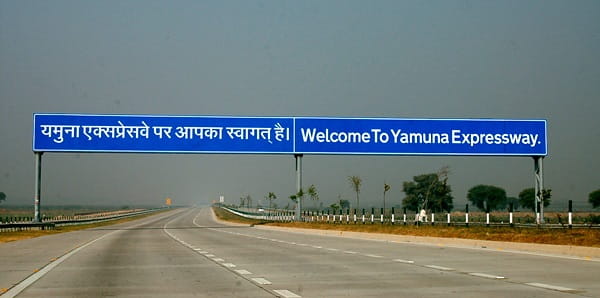
Yamuna Expressway Overview
| Detail | Information |
| Name | Yamuna Expressway / Taj Expressway |
| Current Status | Fully Operational since August 9, 2012 |
| Location | Western Uttar Pradesh |
| Route | Pari Chowk, Greater Noida → Kuberpur, Agra (NH-2) |
| Total Length | 165.5 km |
| Lanes | 6 lanes (expandable to 8) |
| Speed Limit | 100 km/h (cars); 60 km/h (heavy vehicles) |
| Winter Speed Limit | Reduced to 75 km/h (cars) during fog season — Dec 15 to Feb 15 |
| Toll Rate (Cars) | ₹2.65 per km |
| Approximate Full Journey Toll (Cars) | Approx. ₹438 one-way |
| Round Trip Discount | 1.6x one-way toll if completed within 24 hours |
| Toll Plazas | 3 main plazas (at 38 km, 95 km, 150 km from Greater Noida) |
| Toll — Buses/Trucks | ₹7.85 per km |
| Toll — Heavy Vehicles | ₹11.94 per km |
| FASTag | Mandatory since June 15, 2021 |
| Governing Authority | YEIDA (Yamuna Expressway Industrial Development Authority) |
| Daily Traffic | 100,000+ vehicles |
| Key Connectivity | Delhi NCR to Agra, Mathura, Vrindavan, Jewar Airport |
Route and Location
The expressway begins at Pari Chowk in Greater Noida — the junction that also serves as the terminal station for the Noida-Greater Noida Metro Aqua Line — and runs southward through the Yamuna floodplain zone passing Jewar, the site of the upcoming Noida International Airport, before continuing through Vrindavan and Mathura approach zones and terminating at Kuberpur on NH-2 at Agra’s northwestern boundary.
The route was built in three phases by Yamuna Expressway Industrial Development Authority and the concession was awarded to Jaypee Infratech Limited. Six interchanges punctuate the route at regular intervals — Jewar, Tappal, Hathras, Mathura, and the approach points near Agra — allowing selective entry and exit for travelers whose destinations fall short of the full Agra run.
Speed Limits and Toll
The 100 km/h general limit drops to 75 km/h during fog season from December 15 to approximately February 15 — a seasonal adjustment that reflects the Yamuna floodplain’s winter visibility conditions which create genuine driving hazards on a high-speed corridor where vehicles otherwise move at expressway velocities. The toll rate of ₹2.65 per kilometre for cars — revised upward from ₹2.50 in September 2022 — puts the full Greater Noida-to-Agra run at approximately ₹438 one-way for a car. The round trip discount of 1.6x the one-way fare when returning within 24 hours makes the expressway accessible for same-day Agra tourism runs from Delhi.
Nearby Areas
Jewar International Airport: Under construction along the expressway’s northern section, this airport when complete will generate an enormous new traffic dimension along the corridor — aviation passengers, cargo operators, and the residential development around the airport all adding to the expressway’s daily load. Mathura and Vrindavan: Among India’s most visited religious cities, these twin pilgrim destinations are accessible via the expressway interchanges and the improved connectivity has significantly boosted weekend and festival pilgrim traffic from Delhi NCR. Agra: The Taj Mahal city at the expressway’s southern terminus is its defining cultural anchor — the single most visited tourist destination in India, and the expressway’s time savings make Agra a realistic same-day trip from Delhi in a way it previously was not.
Frequently Asked Questions (FAQs)
Q1. What is the Yamuna Expressway and when did it open?
A: A 165.5 km six-lane controlled-access expressway connecting Greater Noida to Agra, fully operational since August 9, 2012.
Q2. What is the current toll rate on Yamuna Expressway?
A: ₹2.65 per km for cars — approximately ₹438 for the full Greater Noida to Agra journey. FASTag mandatory.
Q3. What is the speed limit on Yamuna Expressway?
A: 100 km/h for cars generally; reduced to 75 km/h during fog season (December 15 to mid-February). Heavy vehicles limited to 60 km/h.
Q4. How much time does Yamuna Expressway save for Delhi-Agra travel?
A: The journey reduces from 4 hours on the old NH-2 to approximately 2 to 2.5 hours, saving 1.5 to 2 hours.
Q5. Is FASTag mandatory on Yamuna Expressway?
A: Yes, mandatory since June 15, 2021. Vehicles without FASTag pay double the toll rate.