
Eastern Uttar Pradesh has always felt like a different country from the western half of the state. While districts around Agra, Mathura, and the Lucknow belt have benefited progressively from improving road connectivity and industrial investment, the Purvanchal region — stretching from Lucknow eastward through Ayodhya, Sultanpur, Azamgarh, and Ghazipur toward the Bihar border — remained stubbornly difficult to traverse at any reasonable speed. Roads were narrow, towns frequent, and the journey from Lucknow to Ghazipur by road tested the patience of even experienced UP travelers. The Purvanchal Expressway arrived as a direct and substantial answer to that problem, and its impact on eastern UP’s connectivity, economic prospects, and daily quality of life has been considerable.
The expressway is significant for reasons beyond transport. Eastern Uttar Pradesh carries an enormous agricultural economy — rice, wheat, sugarcane, and vegetables flow through its markets in volumes that demand efficient logistics. It is also home to some of India’s most spiritually significant places — Ayodhya, which sits within the expressway’s direct influence zone, draws millions of pilgrims annually whose travel experience has been transformed by the road’s opening. And it is a region with one of India’s largest diaspora populations — particularly in the Gulf states and United Kingdom — whose visits home are now considerably less arduous than they once were. For all these reasons, the Purvanchal Expressway is not just a road. It is a long-overdue infrastructure commitment to one of India’s most populous and historically underserved regions.
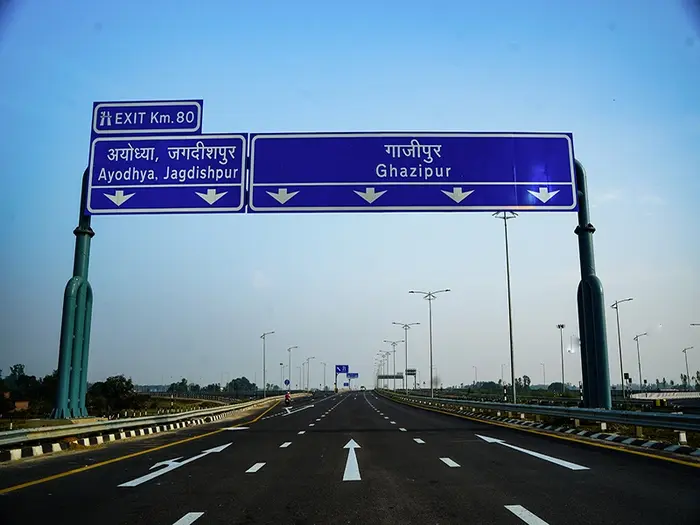
Purvanchal Expressway, Uttar Pradesh – Quick Overview
|
Detail |
Information |
|
Full Name |
Purvanchal Expressway |
|
Total Length |
Approx. 340.82 km |
|
States Covered |
Uttar Pradesh |
|
Starting Point |
Lucknow (Chand Sarai village), Uttar Pradesh |
|
Ending Point |
Ghazipur (Hydaria village), Uttar Pradesh |
|
Highway Classification |
State Expressway — managed by UPEIDA |
|
Number of Lanes |
6 lanes (expandable to 8 lanes) |
|
Speed Limit |
120 km/h for cars; 60 km/h for heavy vehicles |
|
Toll Collection |
FASTag-enabled electronic toll plazas |
|
Car Toll Fee (One Way) |
Approx. ₹655–₹710 (full route) |
|
Heavy Vehicle Toll |
Approx. ₹2,100–₹2,500 depending on axle category |
|
Governing Authority |
Uttar Pradesh Expressways Industrial Development Authority (UPEIDA) |
|
Passes Through |
Barabanki, Amethi, Sultanpur, Ayodhya vicinity, Azamgarh, Mau, Ghazipur |
|
Unique Feature |
Airstrip for emergency aircraft landing; longest expressway in UP at time of opening |
Route and Location
The Purvanchal Expressway begins at Chand Sarai village on the eastern outskirts of Lucknow — connecting at this western end to the Lucknow Ring Road and through it to the Agra Lucknow Expressway — and travels eastward through the agricultural plains and district towns of eastern Uttar Pradesh before terminating at Hydaria village near Ghazipur on the Bihar border.
Leaving Lucknow, the expressway passes through Barabanki — one of the most agriculturally productive districts in central UP, known for its rice cultivation and proximity to Lucknow’s expanding satellite townships. Continuing eastward, the route enters Amethi district, which carries its own political and historical significance as one of the most closely watched parliamentary constituencies in India. From Amethi, the expressway passes through Sultanpur — an important administrative and commercial town on the Gomti River — before continuing southeast through the Faizabad and Ambedkar Nagar belt that sits in the spiritual shadow of Ayodhya, just a short distance north of the expressway’s main alignment.
The eastern section of the route passes through Azamgarh — one of eastern UP’s largest and most historically complex urban centers — and continues through Mau, a significant handloom and textile manufacturing district, before reaching Ghazipur on the Bihar border. Ghazipur carries its own historical distinction as a colonial-era trading post and the location of Lord Cornwallis’s tomb, and its positioning as the expressway’s eastern terminus makes it a logical gateway between Uttar Pradesh and Bihar.
This east-west orientation through UP’s Ganga plain means the expressway traverses some of the most densely settled agricultural territory in the world — a fact that made land acquisition for this project both politically sensitive and logistically complex, making its completion within a reasonable timeframe a genuine administrative achievement.
Length and Road Specifications
At 340.82 kilometres, the Purvanchal Expressway was the longest expressway in Uttar Pradesh at the time of its inauguration in November 2021, though it has since been surpassed in that distinction by the Ganga Expressway. The six-lane divided carriageway is built with structural provisions for expansion to eight lanes as eastern UP’s traffic volumes grow with economic development along the corridor.
The road is fully access-controlled throughout its length with no at-grade intersections on the main carriageway. Grade-separated interchanges at major district headquarters and towns distribute access appropriately. An airstrip section near Sultanpur — a recurring design feature of UP’s major expressways — provides emergency landing capability for military and disaster management aircraft, reinforcing the expressway’s dual civilian and strategic utility.
Rest areas and fuel stations are distributed at regular intervals, recognising that 340 kilometres is a substantial single-session drive that demands adequate driver rest infrastructure along the way. The flat topography of eastern UP’s Ganga plain simplifies road construction geometry while simultaneously increasing the monotony risk for drivers on long straight sections — a factor that road safety authorities have specifically flagged for this corridor.
Speed Limit
The Purvanchal Expressway carries a 120 kilometre per hour maximum speed limit for private cars and light motor vehicles — consistent with UP’s most ambitious expressway corridors and one of the higher permitted speeds on any road in northern India. Heavy commercial vehicles are restricted to 60 km/h throughout. The combination of the expressway’s long straight sections and the 120 km/h limit creates conditions where speed management and driver fatigue are genuine safety considerations, particularly during nighttime hours and the winter fog season when the eastern UP plains experience some of the densest fog conditions anywhere in the country.
UP expressway traffic police operate camera surveillance and patrol vehicles along the corridor, with enforcement intensifying seasonally during fog season when speed limits are often temporarily reduced at affected sections for safety purposes.
Toll Fee
Tolling on the Purvanchal Expressway is managed by UPEIDA through electronic barrier plazas distributed across the route. For private cars making the complete Lucknow to Ghazipur journey, the one-way toll is approximately ₹655 to ₹710 — a rate that positions this expressway comparably to the Agra Lucknow Expressway in per-kilometre toll burden. Heavy commercial vehicles pay approximately ₹2,100 to ₹2,500 depending on their axle configuration and category. FASTag is the primary and strongly preferred payment mode at all plazas. Return trip concessions are available at most toll barriers for same-day return journeys within the stipulated time window, providing a modest saving for round-trip travelers.
Frequently Asked Questions (FAQs)
Q1. What is the total length of the Purvanchal Expressway?
The expressway is approximately 340.82 kilometres long, running from Lucknow to Ghazipur near the Bihar border.
Q2. What is the maximum speed limit on the Purvanchal Expressway?
Private cars can travel at up to 120 km/h while heavy vehicles are restricted to 60 km/h throughout.
Q3. What is the one-way car toll for the full Purvanchal Expressway route?
The approximate full-route toll for a private car is ₹655 to ₹710, subject to periodic UPEIDA revision.
Q4. Which major districts does the Purvanchal Expressway pass through?
It passes through Barabanki, Amethi, Sultanpur, Azamgarh, Mau, and Ghazipur from west to east.
Q5. When was the Purvanchal Expressway inaugurated?
The Purvanchal Expressway was inaugurated in November 2021, with Prime Minister Narendra Modi landing on its airstrip section during the opening ceremony.