
India does not have many expressways that can claim to connect three major oil refineries in a single alignment. The Amritsar-Jamnagar Expressway can. The 1,257-kilometre corridor threads through the Bathinda refinery belt in Punjab, the Barmer refinery zone in Rajasthan, and terminates near the enormous Jamnagar refinery complex in Gujarat — creating a petroleum logistics corridor of strategic national significance alongside its freight and passenger connectivity function.
Also designated NH-754 and Economic Corridor 3 (EC-3), this expressway has been under construction since 2021 under the Bharatmala Pariyojana framework. A significant stretch between Hanumangarh and Jalore in Rajasthan opened on July 8, 2023, while PM Narendra Modi inaugurated a crucial Gurugram section on March 11, 2024. As of early 2026, civil works across the expressway are reported approximately 85 to 90 percent complete, with full commissioning targeted for December 2026. Some packages — particularly in the northern Punjab sections — are progressing toward completion while Rajasthan’s extensive middle sections are at various stages of finishing work.
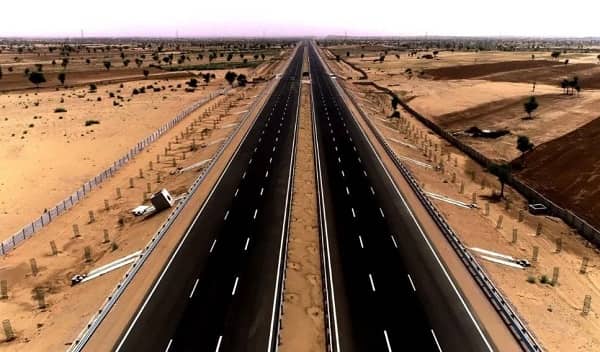
Amritsar Jamnagar Expressway Overview
| Detail | Information |
| Name | Amritsar-Jamnagar Expressway / Amritsar-Jamnagar Economic Corridor (EC-3) |
| Highway Designation | NH-754 |
| Current Status | Under Construction — Partially Operational |
| Sections Open | Hanumangarh-Jalore (since July 8, 2023); Gurugram section (since March 2024) |
| Full Commissioning Expected | December 2026 |
| Route | Tibba Village, Kapurthala, Punjab → Jamnagar, Gujarat |
| Total Length | 1,257 km |
| States Covered | Punjab, Haryana, Rajasthan, Gujarat |
| Key Cities Along Route | Amritsar, Sultanpur Lodhi, Moga, Bathinda, Mandi Dabwali, Hanumangarh, Suratgarh, Bikaner, Nagaur, Jodhpur, Barmer, Jamnagar |
| Lanes | 4 to 6 lanes (partially access-controlled) |
| Speed Limit | 120 km/h (cars on access-controlled sections) |
| Toll Fee | Not fully notified — operational sections have active toll collection |
| Greenfield Length | 915.85 km of 1,257 km total |
| Total Estimated Cost | Approx. ₹80,000 crore |
| Governing Authority | NHAI under Bharatmala Pariyojana Phase I |
| Travel Time After Completion | Amritsar to Jamnagar: 13–14 hours (versus 23–26 hours currently) |
Route and Location
The expressway starts from Tibba village in Kapurthala’s Sultanpur Lodhi tehsil in Punjab — connecting to the Delhi-Amritsar-Katra Expressway’s NE-5A alignment — and runs southward through Punjab’s Moga, Faridkot, and Bathinda districts. Crossing into Haryana near the Mandi Dabwali zone, it continues southward before entering Rajasthan at Hanumangarh district.
The Rajasthan stretch is the expressway’s longest — running through the vast Thar Desert landscape of Hanumangarh, Suratgarh, Bikaner, Nagaur, Jodhpur, and Barmer districts before crossing into Gujarat. The Gujarat section heads southwestward through Banaskantha and Jamnagar districts, terminating near the Jamnagar refinery complex on the Saurashtra coast.
Of the total 1,257 kilometres, approximately 915.85 kilometres are being built on a fresh greenfield alignment — carving new road corridors through agricultural and desert terrain that currently has no high-quality road access — while the remainder upgrades existing national highway stretches to expressway standards.
Speed Limits and Toll
Access-controlled sections of this corridor carry the 120 km/h speed designation. The partially access-controlled sections on upgraded brownfield stretches have lower posted limits consistent with their road character. Toll collection is active on the Hanumangarh-Jalore section that has been operational since 2023. Full expressway toll notification across the complete 1,257 kilometres will follow the final commissioning in December 2026.
Nearby Areas
Bathinda Refinery: The Guru Gobind Singh Refinery at Bathinda — one of India’s most modern petroleum refineries — is the northern anchor of the refinery connectivity story this expressway tells, with petroleum product logistics being a major use case for the corridor. Bikaner: The historic Rajasthan city known for its medieval fort, Karni Mata temple, and its famous bikaneri bhujia snack industry sits along the expressway’s mid-Rajasthan section. Jamnagar Refinery Complex: Reliance Industries’ twin refineries at Jamnagar — together comprising the world’s largest single-location oil refinery — are the southern terminus anchor, making this expressway a direct lifeline between India’s northwestern petroleum infrastructure and its Punjab-Punjab border zone.
Frequently Asked Questions (FAQs)
Q1. Is Amritsar Jamnagar Expressway open?
A: Partially — the Hanumangarh-Jalore section opened July 2023 and Gurugram section opened March 2024. Full commissioning targeted December 2026.
Q2. How long is Amritsar Jamnagar Expressway?
A: 1,257 kilometres from Tibba village near Kapurthala in Punjab to Jamnagar in Gujarat.
Q3. Which states does Amritsar Jamnagar Expressway pass through?
A: Punjab, Haryana, Rajasthan, and Gujarat — four states spanning northern and western India.
Q4. What is the speed limit on Amritsar Jamnagar Expressway?
A: 120 km/h on access-controlled sections. Speeds vary on partially access-controlled brownfield stretches.
Q5. How much time will Amritsar Jamnagar Expressway save?
A: Amritsar to Jamnagar travel time reduces from 23 to 26 hours to approximately 13 to 14 hours after full completion.