
The dictionary definition of greenfield is simple: land that has never been developed. In India’s infrastructure vocabulary, a greenfield expressway carries that meaning literally — a highway built on completely fresh alignment, unencumbered by existing roads, settlements, or infrastructure. The contrast with brownfield projects is practical and significant. A brownfield widening or upgrade inherits the geometric constraints of whatever road it improves: its curves, its junction points, its proximity to buildings and utilities accumulated over decades of adjacent development. A greenfield expressway draws its line across the map from scratch, choosing the most efficient path between two points and trusting land acquisition and construction to make that line real.
India is in the middle of its most ambitious greenfield expressway construction phase ever. The Bharatmala Pariyojana — launched in July 2015 and formally approved in October 2017 with Phase I committing approximately ₹10.63 lakh crore to 83,677 kilometres of new national highway infrastructure — placed greenfield corridors at the centre of its programme. As of 2025, India has over 6,000 kilometres of operational expressways with more than 11,000 kilometres under active construction. More than 15 additional greenfield expressways worth over ₹1.1 lakh crore were in design or tendering stages as of 2024-25.
The design standard for India’s greenfield expressways under Bharatmala is consistent: 12-lane wide infrastructure with initial 8-lane construction, a median reservation for future 4-lane expansion, maximum design speed of 120 km/h for all vehicles, and access control at every junction — meaning no level crossings, no traffic signals, and no at-grade intersections anywhere on the corridor. The alignment is routed through agricultural and revenue land away from dense habitation wherever possible, for both cost and speed-of-construction reasons.
The Delhi-Mumbai Expressway at 1,386 km is the most discussed example — but the greenfield pipeline extends to every major interregional corridor in the country. The Bengaluru-Chennai Expressway (262 km, NE-7), the Amritsar-Jamnagar Expressway (1,257 km, NH-754), the Varanasi-Kolkata Expressway (710 km, NH-319B), the Gorakhpur-Siliguri Expressway (519 km), the Pune-Bangalore Expressway (700 km), the Narmada Expressway (906 to 1,300 km, Madhya Pradesh), and the Delhi-Dehradun Expressway (210 km, inaugurated April 14, 2026) all represent the greenfield model applied at different scales across different geographies.
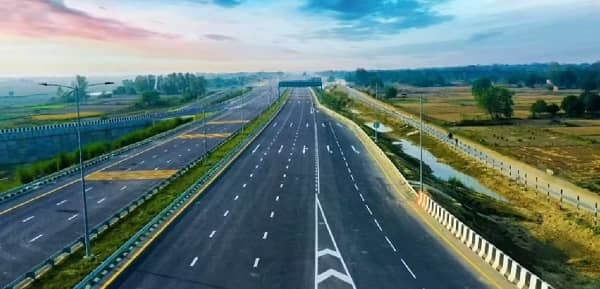
Greenfield Expressway Overview
| Detail | Information |
| Concept | Expressway on entirely new land — no pre-existing alignment |
| Policy Framework | Bharatmala Pariyojana Phase I — ₹10.63 lakh crore, 83,677 km |
| Design Standard | 12-lane wide; 8-lane initial construction; 4-lane median reservation |
| Speed | 120 km/h for all vehicle types |
| Junction Type | Fully access-controlled — no level crossings, no signals |
| Operational Expressways | 6,000+ km (2025) |
| Under Construction | 11,000+ km (2025) |
| Key Advantage | Straight new alignment — shorter, faster, no existing constraints |
| Key Challenge | Land acquisition across private agricultural holdings |
| Delhi-Mumbai (Longest) | 1,386 km, 8-lane, 6 states — India’s longest |
| Amritsar-Jamnagar | 1,257 km, NH-754 — India’s second-longest |
| Bengaluru-Chennai | 262 km, NE-7 — 3 states; Karnataka section open Dec 2024 |
| Varanasi-Kolkata | 710 km, NH-319B — 4 states; target 2027 |
| Delhi-Dehradun | 210 km, NH-709B — inaugurated April 14, 2026 |
| Narmada Expressway | 906–1,300 km, MP — DPR stage, pre-construction 2025 |
| Gorakhpur-Shamli | 700–750 km, UP — DPR complete Dec 2025; construction from 2026 |
| Pipeline (15+ projects) | Over ₹1.1 lakh crore in design/tendering stage (2024-25) |
Why Greenfield Alignment Is Transformative
The geometry of a straight new line through open countryside does something that no widening of an old highway can replicate: it removes accumulated inefficiency. Old national highways in India accumulated towns, truck stops, religious structures, and encroachments across decades — each one a constraint on widening and a friction point on speed. A greenfield expressway has none of that history. Every interchange is designed for its purpose from the start. Every curve reflects terrain, not the ghost of a village that once made a road turn.
The Delhi-Mumbai Expressway demonstrates this clearly — its new alignment is approximately 150 kilometres shorter than the existing NH-48 route, not because it travels faster but because it travels straighter. The Gorakhpur-Shamli Expressway will save 200 kilometres compared to the current Delhi-via-Lucknow detour for the same reason.
State-Level Greenfield Programmes
Beyond national projects, state governments are commissioning their own greenfield pipelines. Rajasthan alone has announced nine new greenfield expressways — Jaipur-Bhilwara (193 km), Bikaner-Kotputli (295 km), Beawar-Bharatpur (342 km), Jalore-Jhalawar (402 km), Ajmer-Banswara (358 km), Jaipur-Phalodi (345 km), Sri Ganganagar-Kotputli (290 km), and others. Uttar Pradesh is pursuing the Gorakhpur-Shamli Expressway as its longest-ever greenfield corridor. Maharashtra’s Pune-Bangalore Expressway at 700 km, Karnataka and Tamil Nadu’s NE-7, and Bihar’s role in the Gorakhpur-Siliguri Expressway all represent this state-level greenfield ambition running alongside the national Bharatmala programme.
Frequently Asked Questions (FAQs)
Q1. What is a Greenfield Expressway in India?
A: A new access-controlled highway on completely fresh land — no pre-existing road, designed as 12-lane wide with initial 8-lane construction at 120 km/h, under the Bharatmala Pariyojana framework.
Q2. Which is India’s longest Greenfield Expressway?
A: The Delhi-Mumbai Expressway at 1,386 km — 8-lane across 6 states, reducing Delhi-Mumbai travel from 24 to 12 hours.
Q3. How many km of expressways does India have as of 2025?
A: Over 6,000 km operational, with over 11,000 km under active construction — the largest simultaneous expressway build in Indian history.
Q4. What is the key technical advantage of a Greenfield Expressway?
A: A straight new alignment that is shorter, faster, and free of all the historical constraints — buildings, encroachments, level crossings — that old highways accumulate over decades.
Q5. What are Rajasthan’s upcoming Greenfield Expressways?
A: Nine projects including Jaipur-Bhilwara (193 km), Bikaner-Kotputli (295 km), Beawar-Bharatpur (342 km), Jalore-Jhalawar (402 km), and Ajmer-Banswara (358 km) — all in DPR or early preparation stage as of 2025.