
India has built many highways, but the Delhi Mumbai Expressway occupies a category of its own. When completed in full, it will be the longest expressway in the country — a 1,386-kilometre corridor that fundamentally reimagines how people, goods, and commerce move between the national capital and the country’s financial capital. For decades, the journey between Delhi and Mumbai by road was an endurance test involving multiple state highways, congested towns, and overnight drives that tested patience as much as engines. This expressway changes that calculation entirely, promising to cut travel time between the two cities to approximately 12 hours — roughly half of what the older road alignment required.
The project is more than a road. It is a development corridor designed to stimulate economic growth across six states, pass through some of India’s most investment-hungry regions, and connect industrial clusters, logistics hubs, and urban centers that have historically been underserved by high-quality road infrastructure. Rajasthan’s dry industrial belt, Madhya Pradesh’s emerging manufacturing zones, and Gujarat’s petrochemical corridor all benefit from this expressway in ways that extend well beyond passenger convenience. For truck operators, logistics companies, passenger bus services, and private travelers, the Delhi Mumbai Expressway represents a generational upgrade in India’s road infrastructure ambition.
| Detail | Information |
| Full Name | Delhi Mumbai Expressway |
| Also Known As | Delhi Mumbai Greenfield Expressway / NE-4 |
| Total Length | Approx. 1,386 km |
| States Covered | Delhi, Haryana, Rajasthan, Madhya Pradesh, Gujarat, Maharashtra |
| Starting Point | Dwarka, Delhi |
| Ending Point | JNPT, Mumbai, Maharashtra |
| Highway Classification | National Expressway — NE-4 |
| Number of Lanes | 8 lanes (expandable to 12 lanes) |
| Speed Limit | 120 km/h for cars; 80 km/h for buses; 60 km/h for heavy vehicles |
| Toll Collection | FASTag-enabled electronic toll plazas |
| Estimated Car Toll (Full Route) | Approx. ₹1,500–₹2,000 (subject to revision) |
| Governing Authority | NHAI |
| Passes Through | Gurugram, Jaipur, Vadodara, Surat |
| Completion Status | Partially operational; phased completion ongoing |
Route and Location
The Delhi Mumbai Expressway begins at Dwarka in southwestern Delhi and sweeps southwestward through Haryana’s Gurugram and Rewari districts before entering Rajasthan — the state that accounts for the single largest portion of the expressway’s total length. Within Rajasthan, the road passes through Alwar, Dausa, and the outskirts of Jaipur before continuing south through Kota and into Madhya Pradesh. The Madhya Pradesh segment passes through Ratlam and approaches the Gujarat border, where the expressway connects into the state’s growing road network passing near Vadodara and Surat before entering Maharashtra and terminating at the Jawaharlal Nehru Port Trust zone near Mumbai.
What makes this routing particularly significant is its deliberate alignment through greenfield and semi-developed regions rather than through existing congested urban cores. This approach serves a dual purpose — it avoids the land acquisition and demolition complexities of urban alignment while simultaneously driving infrastructure investment into areas that have historically received far less of it. The eight-lane carriageway with provisions for twelve-lane expansion reflects projections of traffic growth that planners expect will materialize rapidly once the full corridor is operational.
Length and Road Specifications
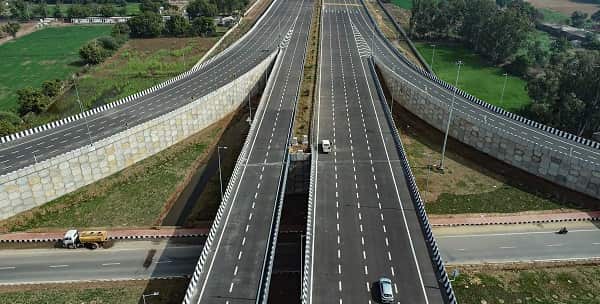
At 1,386 kilometres, the Delhi Mumbai Expressway surpasses every previously completed expressway in India for sheer length, making it a landmark project in the country’s National Infrastructure Pipeline. The road is designed as a fully access-controlled greenfield expressway with grade-separated interchanges at all major junctions. No at-grade crossings, signals, or pedestrian pathways interrupt the main carriageway, allowing consistent high-speed travel throughout the route.
The expressway incorporates several notable engineering features including wildlife underpasses and overpasses through ecologically sensitive areas of Rajasthan, which represent a meaningful step toward integrating large-scale road infrastructure with environmental responsibility. Rest areas, fuel stations, food courts, and emergency response stations are planned at regular intervals throughout the corridor.
Speed Limit
Private cars and light motor vehicles can travel at a maximum of 120 kilometres per hour on the Delhi Mumbai Expressway. Buses and medium commercial vehicles carry an 80 km/h limit, while heavy trucks and multi-axle vehicles are restricted to 60 km/h. Speed enforcement relies on advanced camera surveillance and NHAI patrol teams stationed across the corridor’s enormous length.
Toll Fee
Given the expressway’s phased rollout and the multiple state jurisdictions it passes through, toll rates are structured section by section rather than as a single end-to-end fee. For the fully operational Delhi to Dausa section, private cars pay approximately ₹295 to ₹400 for a one-way trip through that segment. Estimates for the full Delhi to Mumbai corridor suggest a total car toll in the range of ₹1,500 to ₹2,000 once all sections are operational and unified under NHAI’s toll framework. Heavy commercial vehicles will naturally attract significantly higher rates given the greater infrastructure wear their axle loads impose. All toll collection is FASTag-based across operational sections.
Frequently Asked Questions (FAQs)
Q1. What is the total length of the Delhi Mumbai Expressway?
A: The expressway stretches approximately 1,386 kilometres from Dwarka in Delhi to JNPT near Mumbai.
Q2. How many states does the Delhi Mumbai Expressway pass through?
A: It passes through six states — Delhi, Haryana, Rajasthan, Madhya Pradesh, Gujarat, and Maharashtra.
Q3. What is the speed limit for cars on this expressway?
A: Private cars are permitted a maximum speed of 120 km/h throughout the expressway corridor.
Q4. Is the entire Delhi Mumbai Expressway operational?
A: The expressway is being opened in phases. Several sections are fully operational while others are under advanced stages of completion.
Q5. What is the approximate toll for a car on the full Delhi Mumbai route?
A: The estimated full-route toll for a private car is approximately ₹1,500 to ₹2,000, subject to NHAI revision upon full completion.