
The relationship between Delhi and Dehradun has always been one of aspiration pointed northward. Every winter weekend and every summer school holiday sees a stream of vehicles leaving the capital toward the Doon Valley — the gateway city for Mussoorie, Rishikesh, Haridwar, and the Char Dham pilgrimage circuit beyond. Until April 2026, this journey took between five and six hours on the NH-58 corridor through Ghaziabad, Meerut, Muzaffarnagar, and Roorkee — a route whose four-lane limitations and the dense commercial traffic of western UP made it chronically slower than its distance warranted. The Delhi-Dehradun Expressway changed that equation permanently when Prime Minister Narendra Modi inaugurated it on April 14, 2026.
The expressway — officially designated NH-709B and also known as the Delhi-Saharanpur-Dehradun Economic Corridor — is a 210-kilometre greenfield and brownfield expressway connecting Akshardham in Delhi to Dehradun in Uttarakhand. Built at approximately ₹11,963 to ₹13,000 crore by NHAI under the Bharatmala Pariyojana on an EPC model, it reduces the Delhi-Dehradun journey to 2.5 hours from the current five to six, passing through three states — Delhi, Uttar Pradesh, and Uttarakhand — across the districts of Baghpat, Baraut, Shamli, and Saharanpur.
The expressway is designed as six lanes expandable to eight and even twelve lanes, with a dedicated 76-kilometre service road to handle city-level traffic separately. Its most environmentally distinctive feature is Asia’s longest elevated wildlife corridor — a 4.82-kilometre elevated flyover through Rajaji National Park with a 6-metre vertical clearance underneath, designed to allow elephants and other wildlife to cross beneath the expressway without disruption. Two key spur expressways connect to it: the 50.7-kilometre Saharanpur-Roorkee-Haridwar Expressway and the 121-kilometre Ambala-Shamli Expressway, giving the corridor reach into the Haridwar pilgrimage zone and the Punjab-UP border zone respectively.
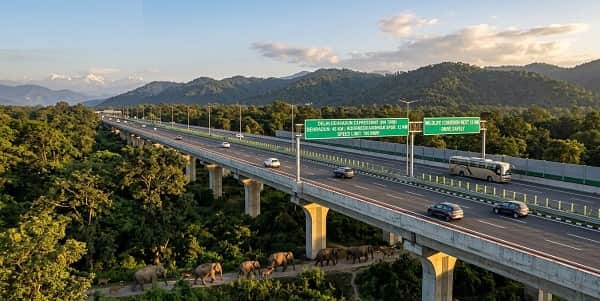
Dehradun Delhi Expressway Overview
| Detail | Information |
| Name | Delhi-Dehradun Expressway / Delhi-Saharanpur-Dehradun Economic Corridor |
| Highway Number | NH-709B |
| Maintained By | NHAI |
| Length | 210 km |
| Lanes | 6-lane (expandable to 8 and 12) |
| From | Akshardham, Delhi |
| To | Dehradun, Uttarakhand |
| Inaugurated | April 14, 2026 (PM Narendra Modi) |
| Project Cost | ₹11,963–₹13,000 crore |
| Construction Model | EPC — Bharatmala Pariyojana |
| States Covered | Delhi, Uttar Pradesh, Uttarakhand |
| Key Districts | Baghpat, Baraut, Shamli, Saharanpur |
| Travel Time | 2.5 hours (vs current 5–6 hours) |
| Speed Limit | Up to 100 km/h |
| Service Road | 76 km dedicated service road for city traffic |
| Phase 1 | Delhi to Baghpat — 31.2 km |
| Phase 2 | Baghpat to Saharanpur — 118 km |
| Phase 3 | Saharanpur to Ganeshpur — 40 km |
| Phase 4 | Ganeshpur to Dehradun — 20.7 km (includes tunnels and elevated wildlife corridor) |
| Wildlife Corridor | 4.82 km elevated corridor through Rajaji National Park — Asia’s longest |
| Spur 1 | Saharanpur–Roorkee–Haridwar Expressway — 50.7 km, 6-lane |
| Spur 2 | Ambala–Shamli Expressway — 121 km, 6-lane |
Route and Location
The expressway begins at Akshardham in eastern Delhi and runs northeastward through Baghpat, Baraut, and Shamli in western Uttar Pradesh before entering Saharanpur district — the historic wood-carving city at the junction of Haryana, UP, and Uttarakhand. From Saharanpur it runs northward through Ganeshpur toward the Doon Valley, passing through a two-tube tunnel before the elevated wildlife corridor section through Rajaji National Park, and descending into Dehradun.
Connectivity
The Haridwar Spur (50.7 km) connects the expressway to the Haridwar pilgrimage zone and the Char Dham highway network. The Ambala-Shamli Spur (121 km) extends connectivity westward into Haryana and Punjab. The Eastern Peripheral Expressway at Phase 1’s Delhi end connects to Noida and the NCR orbital network.
Nearby Areas
Rajaji National Park — with its elephant corridors and rich biodiversity — is the ecologically significant zone through which the expressway’s Phase 4 passes, protected by the elevated wildlife corridor. Mussoorie, accessible from Dehradun in 30 to 40 minutes, is the expressway’s primary leisure tourism destination. Haridwar and Rishikesh, accessible via the 50.7-kilometre spur, are the sacred river cities that draw millions of pilgrims annually through this corridor.
Frequently Asked Questions (FAQs)
Q1. When was the Delhi Dehradun Expressway inaugurated?
A: April 14, 2026 by Prime Minister Narendra Modi. The 210-km corridor runs from Akshardham (Delhi) to Dehradun via Saharanpur.
Q2. How long does it take from Delhi to Dehradun on the new expressway?
A: Approximately 2.5 hours — reduced from the earlier 5 to 6 hours.
Q3. What is Asia’s longest elevated wildlife corridor on this expressway?
A: A 4.82-km elevated flyover through Rajaji National Park with 6-metre clearance beneath, allowing elephants and wildlife to cross safely under the expressway.
Q4. What are the two spur expressways connected to Delhi-Dehradun Expressway?
A: The 50.7-km Saharanpur-Roorkee-Haridwar Expressway and the 121-km Ambala-Shamli Expressway.
Q5. What is the estimated cost of the Delhi-Dehradun Expressway?
A: Approximately ₹11,963 to ₹13,000 crore under the Bharatmala Pariyojana EPC model.