
Delhi’s traffic problem has always been partly a geography problem — too many vehicles from too many directions trying to pass through the city rather than around it. The Eastern Peripheral Expressway solved the eastern bypass question with a confidence that matched the speed of its construction. Built in a remarkable 500 days against a scheduled 910 days, PM Narendra Modi inaugurated it on May 27, 2018, alongside the Western Peripheral Expressway — together forming the largest ring road around Delhi.
The EPE’s formal designation is the Kundli-Ghaziabad-Palwal Expressway — KGP — and the 135 kilometres it covers running along Delhi’s eastern boundary through Haryana and Uttar Pradesh carry around two lakh vehicles daily that might otherwise add to the capital’s existing traffic burden. NHAI claims it reduces Delhi’s traffic volume by approximately 30 percent and vehicular pollution by 27 percent. It was India’s first solar-powered expressway, with panels installed along the median generating electricity for the expressway’s operational requirements. Since 2022, it has been operated under a Toll-Operate-Transfer model by Maple Highways for a 20-year concession period.
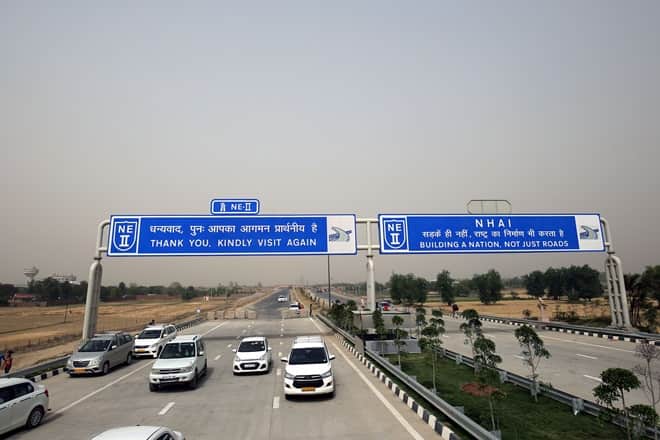
Current Status: Fully Operational since May 27, 2018. Operated by Maple Highways under TOT model since 2022.
Overview Table
| Detail | Information |
| Official Name | Eastern Peripheral Expressway / Kundli-Ghaziabad-Palwal (KGP) Expressway |
| Designation | National Expressway 2 (NE-2) |
| Current Status | Fully Operational since May 27, 2018 |
| Operator | Maple Highways (TOT model since 2022) |
| Route | Kundli, Sonipat, Haryana → Dholagarh, Palwal, Haryana |
| Key Areas Passed | Kundli, Baghpat, Ghaziabad, Greater Noida, Faridabad, Palwal |
| Total Length | 135 km |
| States Covered | Haryana and Uttar Pradesh |
| Lanes | 6 lanes (3 in each direction) |
| Speed Limit | 120 km/h (cars); 100 km/h (commercial vehicles) |
| Toll System | Closed tolling — pay for distance travelled only |
| Toll — Full Journey (Cars) | Approx. ₹190 for complete 135 km (Kundli to Palwal) |
| Toll — Typical Inter-City Journeys | ₹15–55 for cars on partial sections |
| Monthly Pass | ₹350 for cars |
| Governing Authority | NHAI (TOT operated by Maple Highways) |
| Key Features | India’s first solar-powered expressway; first smart expressway; closed tolling; weigh-in-motion sensors |
| Traffic Diverted | Approx. 2 lakh vehicles daily from Delhi roads |
Route and Location
The EPE begins at Kundli in Sonipat district, Haryana — the northern junction point it shares with the Western Peripheral Expressway, together forming the top of Delhi’s ring road loop — and runs southward along Delhi’s eastern boundary through Baghpat and Ghaziabad in Uttar Pradesh before continuing through Greater Noida and the Faridabad zone back into Haryana, terminating at Dholagarh near Palwal in southern Haryana. The southern endpoint at Palwal mirrors the KMP’s own Palwal terminus, completing the ring.
The Ghaziabad section passes through the most commercially significant portion of the eastern corridor, with interchanges connecting to NH-9, NH-58, and the Noida expressway network. The industrial zones of eastern Ghaziabad and Greater Noida generate the freight and commercial vehicle traffic that makes this bypass essential — trucks traveling between Haryana and UP/UP and further east no longer need to enter Delhi’s congested ring road system.
Speed Limits and Toll
The 120 km/h speed limit for cars is enforced by cameras installed every two kilometres — the expressway’s smart highway designation includes continuous electronic surveillance making speed enforcement more consistent than most Indian expressways. The closed tolling structure means a vehicle traveling only between Ghaziabad and Faridabad pays a fraction of the full journey toll, making it economically viable for shorter inter-city movements within the NCR. Two-wheelers are prohibited on the expressway, consistent with India’s standard access-controlled highway policy.
Nearby Areas
Kundli Industrial Area: The large industrial township at the expressway’s northern terminus is directly connected to both the EPE and KMP networks, benefiting from the ring road’s freight logistics advantages. Ghaziabad and Greater Noida: The expressway’s Uttar Pradesh passage through these rapidly expanding NCR cities provides the most direct inter-city connection between northern and southern NCR without Delhi entry. Faridabad Industrial Belt: Haryana’s most industrially productive city in the southern NCR belt gains efficient connectivity toward the north via EPE without routing through Delhi’s Badarpur-Ashram-Mathura Road corridor.
Frequently Asked Questions (FAQs)
Q1. What is the Eastern Peripheral Expressway and when did it open?
A 135 km six-lane bypass connecting Kundli (Sonipat) to Palwal via Ghaziabad along Delhi’s eastern boundary — fully operational since May 27, 2018. India’s first solar-powered smart expressway.
Q2. What is the toll fee on Eastern Peripheral Expressway?
Approximately ₹190 for the full 135 km journey for cars. Most users pay ₹15–55 for typical inter-city sections. Closed tolling — you pay only for distance traveled.
Q3. What is the speed limit on EPE?
120 km/h for cars and 100 km/h for commercial vehicles, enforced by cameras every 2 kilometres.
Q4. How many vehicles does EPE divert from Delhi daily?
Approximately 2 lakh vehicles daily, reducing Delhi’s traffic volume by about 30 percent.
Q5. Who operates Eastern Peripheral Expressway?
Maple Highways operates it under a Toll-Operate-Transfer (TOT) model secured from NHAI in 2022 for a 20-year concession period.