
Eastern Uttar Pradesh’s expressway story got a new chapter on June 20, 2025, when Chief Minister Yogi Adityanath inaugurated the Gorakhpur Link Expressway — UP’s seventh operational expressway and the infrastructure connection that the eastern region had needed for years. Gorakhpur is one of UP’s most important cities: a major religious center with the famous Gorakhnath Temple, an important railway junction, the commercial hub of the eastern belt, and the city that gave Yogi Adityanath his political identity. Connecting it directly to the Purvanchal Expressway at Azamgarh via a 91-kilometre access-controlled corridor is not just a road project — it is a statement about the seriousness with which UP’s current administration views the economic development of its long-neglected eastern zone.
Before this expressway, traveling from Gorakhpur to Lucknow took approximately six hours on surface roads whose quality varied considerably along the route. The Gorakhpur Link Expressway reduces that to 3.5 hours by providing the missing connection to the Purvanchal Expressway’s high-speed corridor, from where Lucknow, Agra, and Delhi are all reachable via the state’s expanding expressway grid. Toll collection commenced on August 1, 2025, following a brief post-inauguration adjustment period.
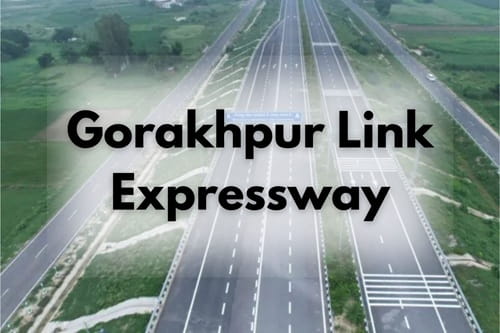
Current Status: Fully Operational. Inaugurated June 20, 2025; tolling commenced August 1, 2025.
Overview Table
| Detail | Information |
| Name | Gorakhpur Link Expressway |
| Current Status | Fully Operational — Inaugurated June 20, 2025 |
| Toll Collection Started | August 1, 2025 |
| Route | Jaitpur Village, Gorakhpur (NH-27) → Salarpur Village, Azamgarh (Purvanchal Expressway) |
| Total Length | 91.35 km |
| Districts Covered | Gorakhpur, Sant Kabir Nagar, Ambedkar Nagar, Azamgarh |
| Lanes | 4 lanes (expandable to 6) |
| Speed Limit | 120 km/h (maximum); 100 km/h general |
| Toll Fee (Cars) | Approx. ₹200 (full journey); ₹2.20 per km rate |
| Toll Fee (Light Commercial) | Higher rates apply per UPEIDA schedule |
| Toll Plazas | 2 main plazas; 3 ramp plazas |
| Project Cost | ₹7,283.28 crore |
| Governing Authority | UPEIDA (Uttar Pradesh Expressways Industrial Development Authority) |
| Inaugurated By | CM Yogi Adityanath |
| Infrastructure | 7 flyovers, 7 major bridges, 27 minor bridges, ATMS surveillance |
| Right of Way | 110 metres |
| Key Connection | Purvanchal Expressway at Salarpur, Azamgarh |
Route and Location
The Gorakhpur Link Expressway begins at Jaitpur village on NH-27 along the Gorakhpur bypass — putting it well-placed to serve the city without requiring travelers to navigate through its dense urban interior. Running southwestward through the agricultural plains of Sant Kabir Nagar and Ambedkar Nagar, the expressway covers 91.35 kilometres before connecting to the Purvanchal Expressway at Salarpur in Azamgarh district.
The route passes through four eastern UP districts that have historically had limited access to high-quality road infrastructure. Land acquisition for the project covered 1,148.8 hectares across 172 villages, with ₹2,030 crore paid in compensation to over 22,000 farmers — a process UPEIDA describes as having been conducted peacefully and with fair compensation, an important detail in a state where land acquisition for infrastructure has occasionally generated friction.
The expressway includes one notable bridge crossing of the Ghaghara River — a major Himalayan river that floods significantly during monsoon — requiring substantial bridge engineering to ensure the expressway’s reliability throughout the year.
Speed Limits and Toll
The Gorakhpur Link Expressway carries a maximum design speed of 120 km/h, with 100 km/h as the operational general limit. At ₹2.20 per kilometre, the per-km rate is among the higher ones in UP’s expressway portfolio, reflecting the significant per-kilometre construction cost of ₹7,283 crore for 91 kilometres. The full journey toll for cars works out to approximately ₹200 — described in media coverage as making this one of UP’s costlier expressways in absolute per-kilometre toll terms. Two-wheelers and three-wheelers are prohibited, consistent with UP’s expressway access policy.
Nearby Areas
Gorakhnath Temple, Gorakhpur: The famous Nath sect temple associated with CM Yogi Adityanath’s religious identity is accessible from the Gorakhpur end of the expressway — the city’s most significant religious landmark and one of UP’s important pilgrimage destinations. Azamgarh: The expressway’s southern terminus at Salarpur connects Azamgarh — a city historically associated with poetry, literature, and the Bhojpuri cultural belt — to UP’s high-speed road network for the first time, with significant economic development implications. Purvanchal Expressway Connection: The junction at Salarpur is the strategic heart of this expressway’s value — from here, the Purvanchal corridor runs westward to Lucknow, where onward connections to Agra, Delhi, and the rest of UP’s expressway network are available.
Frequently Asked Questions (FAQs)
Q1. When was Gorakhpur Link Expressway inaugurated?
June 20, 2025, by UP Chief Minister Yogi Adityanath. Toll collection began August 1, 2025.
Q2. How long is the Gorakhpur Link Expressway?
91.35 kilometres, connecting Gorakhpur to the Purvanchal Expressway at Azamgarh.
Q3. What is the toll fee on Gorakhpur Link Expressway? Approximately ₹200 for the full journey for cars, based on a ₹2.20 per km rate. FASTag is the recommended payment mode.
Q4. How does the expressway reduce Gorakhpur-Lucknow travel time?
It connects Gorakhpur to the Purvanchal Expressway at Azamgarh, reducing the Gorakhpur-Lucknow journey from approximately 6 hours to 3.5 hours.
Q5. Which districts does Gorakhpur Link Expressway pass through?
Four districts — Gorakhpur, Sant Kabir Nagar, Ambedkar Nagar, and Azamgarh.