
There is a particular kind of relief that comes with discovering a road that actually does what it promises. The Kundli Manesar Palwal Expressway — almost universally referred to as the KMP Expressway or the Western Peripheral Expressway — is exactly that kind of road. For anyone who has spent the better part of a morning crawling through Delhi’s traffic trying to get from one side of the NCR to the other, the KMP offers something that once felt almost impossible in this region: a fast, clean, well-maintained bypass that keeps you entirely out of the capital’s congestion while connecting some of Haryana’s most important industrial and urban nodes with genuine efficiency.
Conceived as part of a larger national vision to decongest Delhi by creating a peripheral road network around the capital, the KMP Expressway forms the western arc of what planners envisioned as a complete ring around Delhi. Together with its eastern counterpart — the Kundli Ghaziabad Palwal or KGP Expressway — it forms the Delhi Peripheral Expressway, a project that has fundamentally changed how freight traffic, industrial logistics, and inter-city commuters move through the National Capital Region. Whether you are a truck driver carrying goods between Punjab and Rajasthan, a daily commuter living in Manesar and working in Sonipat, a logistics company routing cargo away from Delhi’s weight restrictions, or simply a traveler trying to reach Palwal from Kundli without touching the capital, the KMP Expressway has become an indispensable part of how the NCR functions.
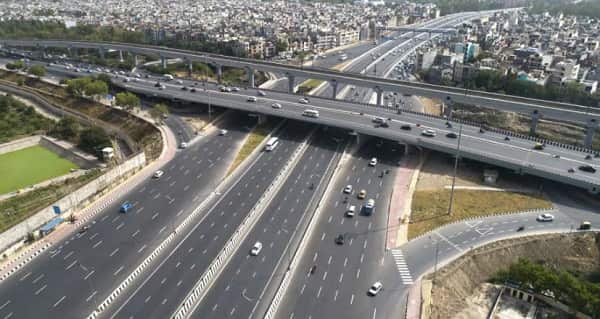
KMP Expressway Overview
| Detail | Information |
| Full Name | Kundli Manesar Palwal Expressway (KMP) |
| Also Known As | Western Peripheral Expressway |
| Total Length | Approx. 135.6 km |
| States Covered | Haryana |
| Starting Point | Kundli, Sonipat District, Haryana |
| Ending Point | Palwal, Faridabad District, Haryana |
| Key Interchange | Manesar, Gurugram District |
| Number of Lanes | 6 lanes (expandable to 8 lanes) |
| Speed Limit | 120 km/h for cars; 60 km/h for heavy vehicles |
| Highway Classification | National Expressway — NE-2 |
| Toll Plazas | Multiple; FASTag-enabled electronic toll collection |
| Operational Since | Fully operational since November 2018 |
| Governing Authority | NHAI and Haryana State Industrial & Infrastructure Development Corporation (HSIIDC) |
| Passes Near | Sonipat, Jhajjar, Gurugram, Faridabad |
Route and Location
The KMP Expressway runs entirely within the state of Haryana, tracing a wide arc around Delhi’s western and southwestern boundary. It begins at Kundli in Sonipat district — the northern anchor point — and sweeps southward through some of Haryana’s most industrially significant districts before terminating at Palwal in Faridabad district in the south.
The expressway passes through or near several important urban and industrial nodes along its 135.6-kilometre length. Moving from north to south, the route covers Kundli and the northern Sonipat industrial belt, crosses through the Jhajjar district corridor, reaches the critical Manesar interchange in Gurugram district — which connects it to NH-48 and the Delhi-Gurugram Expressway — and continues southward through the Sohna and Ballabhgarh belt before terminating at Palwal where it connects to the Yamuna Expressway and NH-19.
The expressway runs roughly parallel to Delhi’s western border, maintaining a distance of approximately 50 to 100 kilometres from the capital at various points. This positioning is deliberate — close enough to serve the NCR’s peripheral industrial and residential zones efficiently, yet far enough to keep through traffic from being drawn into Delhi’s urban congestion at all.
Length and Road Specifications
At 135.6 kilometres, the KMP Expressway is one of the longest greenfield expressways built in Haryana and among the more significant peripheral road projects completed in the NCR region. The road is built to six-lane divided carriageway standards with provisions for expansion to eight lanes as traffic volumes grow — a forward-looking design decision that reflects the anticipated industrial growth along the corridor.
The expressway features a fully access-controlled design, meaning vehicles can only enter and exit at designated interchange points. There are no at-grade intersections, no traffic signals, and no pedestrian crossings along the main carriageway, all of which contribute to the high and consistent traffic speeds the road supports. Interchanges are built as grade-separated flyovers and cloverleaf structures, ensuring smooth merging and diverging of traffic without the speed disruptions common on conventional highways.
Approximately 6 major interchanges dot the KMP’s length, connecting it to NH-44 near Kundli, NH-48 at Manesar, Sohna Road, and the Yamuna Expressway at Palwal — effectively stitching together Haryana’s most important highway corridors into a coherent western arc.
Speed Limit
The KMP Expressway carries a maximum speed limit of 120 kilometres per hour for private cars and light motor vehicles — one of the higher permitted speeds on any road in the NCR region, reflecting the expressway’s high-quality construction and controlled-access design. Heavy commercial vehicles including trucks, buses, and multi-axle freight carriers are governed by a separate limit of 60 kilometres per hour, a restriction that balances the enormous freight traffic this corridor handles with road safety considerations.
Enforcement of speed limits on the KMP is managed through a combination of speed cameras, patrolling by Haryana traffic police, and NHAI’s highway management teams stationed at toll plazas and service roads along the route. Motorists are advised to maintain lane discipline, avoid overtaking from the left, and remain within prescribed speed limits, particularly during night hours when the expressway sees a significant concentration of heavy freight movement.
Key Interchanges and Connectivity
The expressway’s true value lies in its connectivity, and the interchanges it provides are among its most strategically important features. The Manesar interchange is by far the most significant — connecting KMP to NH-48, the Delhi-Gurugram Expressway, and through it to Delhi, Gurugram’s corporate zones, and Rajasthan beyond. This single interchange makes KMP an essential routing option for freight and passenger traffic moving between Punjab, Haryana, Rajasthan, and Gujarat without entering Delhi.
The northern Kundli end connects to NH-44 — the longest national highway in India — providing onward access toward Panipat, Ambala, and Punjab in the north and toward Delhi in the south via the Delhi-Panipat corridor. The southern Palwal terminus connects to the Yamuna Expressway heading toward Mathura and Agra, effectively linking the KMP into the broader western and southern national highway grid.
Toll and FASTag
The KMP Expressway operates a fully electronic tolling system through FASTag-enabled lanes at its multiple toll plazas. Cash lanes are available but increasingly secondary as FASTag adoption across the Indian vehicle fleet has grown substantially. Toll charges vary by vehicle category, with different rates applicable for cars, light commercial vehicles, buses, and multi-axle trucks. Regular commuters and logistics operators using the expressway frequently are advised to maintain adequate FASTag balance to avoid delays at the toll barriers.
Frequently Asked Questions (FAQs)
Q1. What is the total length of the KMP Expressway?
A: The KMP Expressway stretches approximately 135.6 kilometres from Kundli in Sonipat to Palwal in Faridabad district, entirely within Haryana.
Q2. What is the speed limit on the KMP Expressway?
A: Cars can travel at up to 120 km/h while heavy vehicles are restricted to 60 km/h throughout the expressway.
Q3. Does the KMP Expressway pass through Delhi?
A: No, it bypasses Delhi entirely, running through Haryana along the capital’s western periphery connecting Sonipat, Jhajjar, Gurugram, and Faridabad.
Q4. Where does the KMP Expressway connect to NH-48?
A: The Manesar interchange connects KMP directly to NH-48, linking it to the Delhi-Gurugram Expressway and the broader western highway network.
Q5. Is FASTag mandatory on the KMP Expressway?
A: FASTag is the primary payment mode at all KMP toll plazas, and maintaining an active FASTag balance is strongly recommended for smooth, uninterrupted travel.