
A wall-hung toilet is worth its higher price in exactly three situations: you’re already opening the wall during a full renovation, your bathroom is under roughly 60 square feet, and the floating aesthetic genuinely fits your design direction. Outside those conditions, the premium is considerably harder to justify — which is really the whole decision in miniature. This isn’t about one toilet being universally better; it’s about whether your specific bathroom and budget line up with what each design actually offers.
The Core Structural Difference
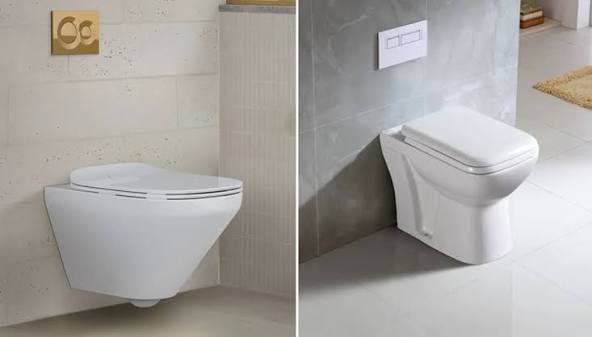
A wall-hung toilet has its tank concealed entirely inside the wall, with only the bowl visible and protruding outward — no floor connection at the base at all. A floor-mounted toilet follows the classic design most people grew up with: a visible tank sitting behind the bowl, with the entire unit connecting down to the floor. This single structural difference cascades into nearly every other distinction between the two.
Space Savings and Bathroom Aesthetics
Wall-hung toilets are considerably more space-efficient, since the tank’s concealment inside the wall frees up visible floor area for other fixtures like sinks or towel racks. They create a modern, minimalist, often “floating” look that particularly suits small or contemporary bathrooms where every inch of visual openness matters. For bathrooms under roughly 60 square feet, this space and visual advantage becomes a genuinely meaningful design consideration rather than just an aesthetic preference.
Floor-mounted toilets lean more traditional, though modern one-piece designs have narrowed this aesthetic gap considerably. For homeowners not specifically prioritizing a contemporary, space-saving look, the traditional floor-mounted style remains a genuinely attractive and familiar choice.
Cleaning and Everyday Maintenance
This is one of the more practically significant differences for daily living. Wall-hung toilets leave the floor completely clear beneath the fixture, making mopping considerably faster and eliminating the seam at the base where grime typically collects on floor-mounted models. If you specifically dislike scrubbing around a toilet’s base, this is a genuine, ongoing quality-of-life advantage that compounds over years of regular cleaning.
Installation Complexity and Cost
Floor-mounted toilets hold a clear advantage here — installation is considerably simpler since there’s no need to open a wall or install a concealed tank and carrier system. A standard floor-mounted installation commonly runs a few hundred dollars.
Wall-hung toilets require considerably more work: the tank needs to be fitted inside the wall using a carrier frame, which typically means opening the wall structure entirely. This installation complexity is reflected directly in cost — wall-hung installations, including the carrier system, typically run well over a thousand dollars, sometimes several times more than a comparable floor-mounted installation. This cost gap is the single biggest practical factor most homeowners weigh in this decision.
Repair and Long-Term Serviceability
Floor-mounted toilets are genuinely easier and less expensive to repair when something goes wrong — the tank and internal components are fully visible and accessible without needing to access wall cavities. Wall-hung toilets, by contrast, require accessing the concealed tank through a service panel or flush plate for even minor repairs, which is more involved and can be more expensive if internal components fail. If your top concern is minimizing hassle and cost when something eventually needs fixing, floor-mounted has a genuine edge.
Stability and Weight Capacity
Properly installed wall-hung toilets, mounted to a reinforced wall with a quality carrier system, are typically tested to hold several hundred pounds and offer genuine stability when installed correctly. That said, floor-standing models are generally considered inherently more stable simply by design, since they don’t rely on wall-mounted structural support bearing the entire load. For wall-hung installations, the quality of the carrier system and wall reinforcement matters considerably more than it does for a floor-mounted toilet’s straightforward, ground-supported design.
Noise Levels
Wall-hung toilets can be slightly quieter during flushing, since the in-wall tank helps muffle sound somewhat, particularly with dual-flush systems. This is a relatively minor consideration for most homeowners but can matter in shared living situations or bathrooms located near bedrooms.
Which One Actually Suits Your Bathroom?
Choose wall-hung if you’re already renovating and opening the wall anyway, your bathroom is genuinely space-constrained, and the modern floating aesthetic matters enough to justify the added installation cost and future repair complexity. Choose floor-mounted if you want the simplest, most affordable installation path, straightforward future repairs, and your bathroom doesn’t have the tight space constraints that make wall-hung’s efficiency genuinely necessary.
The Bottom Line
Wall-hung toilets offer real space efficiency, easier daily cleaning, and a modern aesthetic that suits small or contemporary bathrooms, but that comes with meaningfully higher installation cost and more involved future repairs. Floor-mounted toilets remain the simpler, more affordable, and easier-to-service option that works well for most standard bathroom renovations. The right choice depends less on which toilet is objectively “better” and more on whether your specific bathroom size, renovation scope, and budget align with wall-hung’s genuine advantages.
FAQs
Q1. Is it worth switching to a wall-hung toilet if I’m just replacing an old toilet without any other bathroom renovation?
Generally not — since a standalone toilet swap doesn’t require opening the wall for any other reason, you’d be paying the full wall installation premium purely for the toilet upgrade itself, which is a considerably harder cost to justify than doing it during a full renovation. In that situation, putting the cost difference toward a higher-quality floor-mounted toilet with better flushing performance often delivers more practical value.
Q2. How much harder is it to repair a wall-hung toilet if something breaks years after installation?
Repairs to a wall-hung toilet’s internal components require accessing the concealed tank through a service panel or flush plate, which is more involved and can be costlier than the straightforward, fully visible repair process on a floor-mounted toilet. It’s worth asking your installer specifically about the carrier system’s brand and long-term parts availability before committing, since some systems are considerably easier to service than others.
Q3. Can any bathroom accommodate a wall-hung toilet, or are there structural limitations?
Installing a wall-hung toilet is possible in most bathrooms, but it requires major plumbing and structural changes to accommodate the in-wall tank and carrier system, and the supporting wall generally needs to be reinforced to safely bear the fixture’s weight. Consulting a professional plumber or contractor for a feasibility assessment before committing is genuinely important, since not every wall configuration makes this conversion straightforward or cost-effective.
Q4. Does a wall-hung toilet’s height adjustability offer any real practical benefit?
Yes — because the carrier system determines mounting height rather than a fixed floor connection, wall-hung toilets can be installed at a custom height, which is genuinely useful for households with mobility considerations, taller family members, or accessibility needs. This flexibility isn’t available with a standard floor-mounted toilet, whose height is fixed by the manufacturer’s design.