
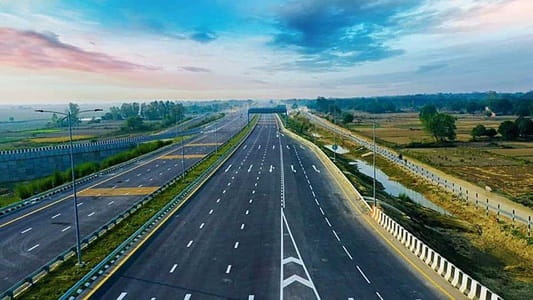
The Delhi-Amritsar-Katra Expressway carries a devotional weight that most infrastructure projects do not. Two of North India’s most visited religious destinations — the Golden Temple in Amritsar and the Vaishno Devi shrine at Katra — sit at its northern ends. For the millions of Sikhs and Hindus who make these journeys annually from Delhi and across the northern plains, a high-speed expressway is not an abstract infrastructure improvement but a practical gift that makes sacred journeys faster, safer, and less physically exhausting.
The 670-kilometre expressway, also designated National Expressway 5 (NE-5) and NE-5A for the Amritsar spur, has been under construction since 2020 across three states — Haryana, Punjab, and Jammu and Kashmir. Progress has been uneven across states: Haryana’s 135-kilometre stretch is largely complete, the J&K sections in the mountains and foothills have progressed significantly, while Punjab’s portions — covering the largest geographic section — have faced the slowest construction pace with approximately 43 to 60 percent completion as of early 2026. Full commissioning across all 670 kilometres is currently expected by March 2027.
| Detail | Information |
| Name | Delhi-Amritsar-Katra Expressway (NE-5 and NE-5A) |
| Current Status | Under Construction — Partially Operational (Haryana sections) |
| Full Commissioning Expected | March 2027 |
| Route | Nilauthi Village (near Bahadurgarh, Delhi border) → Katra, Reasi District, J&K |
| Amritsar Spur (NE-5A) | Nakodar, Punjab → Sri Guru Ram Das Ji International Airport, Amritsar (99 km) |
| Total Length | 670 km (main route + Amritsar spur) |
| States Covered | Haryana, Punjab, Jammu and Kashmir |
| Haryana Section | 135 km — 80–90% complete |
| Punjab Section | Approx. 43–60% complete (as of early 2026) |
| J&K Section | Targeted completion March 2026 per package |
| Lanes | 4 lanes (expandable to 8) |
| Speed Limit | 120 km/h (cars); 80 km/h (heavy vehicles) |
| Estimated Toll (Cars — Delhi to Katra) | Approx. ₹800–1,100 one-way (GPS-based distance tolling) |
| Toll System | GPS-based boothless tolling |
| Governing Authority | NHAI |
| Project Cost | Approx. ₹35,000 crore |
| Travel Time After Completion | Delhi to Katra: 6 hours; Delhi to Amritsar: 4 hours |
| Notable Engineering | 1,300 m cable-stayed bridge over Beas River |
Route and Location
The expressway begins at Nilauthi village near Bahadurgarh where it connects to the KMP Expressway at Delhi’s northwestern boundary. Running northward through Haryana, it covers the districts of Jhajjar, Rohtak, Sonipat, Jind, Kaithal, Karnal, and Ambala before crossing into Punjab. The Punjab alignment passes through Patiala, Sangrur, Ludhiana, Jalandhar, Kapurthala, Tarn Taran, Amritsar, and Gurdaspur districts.
At Nakodar in Punjab, the route bifurcates. The 99-kilometre NE-5A spur heads westward toward Amritsar’s international airport, while the main NE-5 alignment continues northward through Gurdaspur and into Jammu and Kashmir, climbing into the Shivalik foothills before descending to Katra at the base of the Trikuta Mountains.
The J&K section involves the project’s most technically demanding construction — the terrain shifts from plains to foothill ridges and involves multiple tunnels and the dramatic 1,300-metre cable-stayed bridge spanning the Beas River, one of the most visually distinctive pieces of infrastructure on the entire 670-kilometre alignment.
Speed Limits and Toll
The design speed of 120 km/h for cars and 80 km/h for heavy vehicles places this among India’s fastest expressway corridors. The GPS-based boothless tolling system will replace conventional FASTag barrier plazas, calculating charges based on exact entry and exit points. Estimated toll for the full Delhi-to-Katra run is approximately ₹800 to ₹1,100 one-way for cars, though official rates will be formally notified at commissioning.
Nearby Areas
Vaishno Devi Shrine, Katra: The cave shrine of Mata Vaishno Devi above Katra draws over eight million pilgrims annually — among the highest single-site pilgrimage numbers in Asia. The six-hour Delhi-to-Katra journey this expressway enables will meaningfully improve access. Golden Temple, Amritsar: The Harmandir Sahib, holiest site in Sikhism, becomes reachable from Delhi in four hours via the Nakodar spur — a genuinely transformative improvement for the enormous Sikh diaspora population making this pilgrimage from Delhi and the NCR. Ludhiana and Punjab’s Industrial Belt: India’s bicycle and hosiery manufacturing capital sits along the expressway’s Punjab section and will benefit significantly from improved freight connectivity toward Delhi NCR.
Frequently Asked Questions (FAQs)
Q1. Is Delhi Amritsar Katra Expressway open?
Partially — Haryana sections are 80–90% complete. Punjab is slower at 43–60%. Full commissioning expected March 2027.
Q2. What is the estimated toll on Delhi Katra Expressway?
Approximately ₹800 to ₹1,100 one-way for cars on the full Delhi-Katra distance via GPS-based tolling. Final rates announced at commissioning.
Q3. How long is the Delhi Amritsar Katra Expressway?
670 kilometres covering Haryana, Punjab, and J&K, plus a 99 km Nakodar-Amritsar Airport spur.
Q4. What is the speed limit on this expressway?
120 km/h for cars and 80 km/h for heavy vehicles.
Q5. How will this expressway improve travel to Vaishno Devi?
Delhi to Katra will reduce to approximately 6 hours from the current 8-plus hours, significantly improving pilgrimage access for millions of annual visitors.