
Chhattisgarh became a separate state from Madhya Pradesh on November 1, 2000, and immediately faced the infrastructure deficit that newly carved states typically inherit — roads built for sub-regional connectivity rather than state-level needs, and no high-speed corridor linking its two most important cities. Raipur, the state capital, and Bilaspur, the high court city and commercial-industrial hub of northern Chhattisgarh, are 127 kilometres apart on the NH-130/NH-30 corridor — close enough for regular inter-city movement but far enough to demand a modern expressway rather than the conventional two-lane road that existed for the state’s first decade and a half.
The Raipur-Bilaspur Expressway — a 127-kilometre, four-lane tolled expressway linking Tatibandh in Raipur to Darrighat in Bilaspur — is Chhattisgarh’s most commercially important highway project and the state’s busiest expressway. Proposed in 2012, the project faced its most significant obstacle in contractor bankruptcy — the original awardee went insolvent, and NHAI had to restart from scratch in 2016, appointing three contractors to complete the highway in parallel packages. The expressway was finally completed and inaugurated in May 2019 at a cost of approximately ₹15.5 billion. The right of way is 52 metres, the pavement is rigid concrete, and the road includes 35 underpasses for pedestrian and local traffic safety. CCTV surveillance covers the full length with cameras every 5 kilometres, and SOS booths for emergency assistance are placed at regular intervals.
The Raipur-Bilaspur Expressway carries the weight of Chhattisgarh’s economic geography. Bilaspur is not merely the state’s second city — it is the headquarters of South East Central Railway (SECR), one of the busiest railway zones in India for coal freight, and is surrounded by the Korba coal mining belt and the NTPC super thermal power stations that power eastern India. The expressway connects Raipur’s administrative and commercial economy to this industrial-energy complex with reliable high-speed road access for the first time.
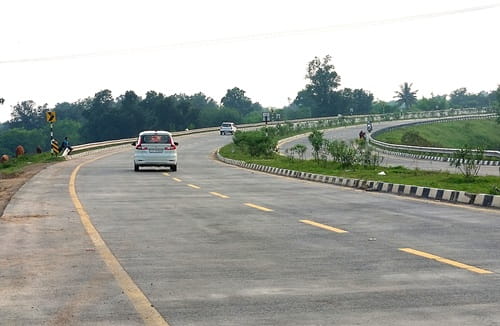
| Detail | Information |
| Name | Raipur-Bilaspur Expressway |
| Highways | NH-130 and NH-30 |
| Length | 127 km |
| Lanes | 4-lane (6-lane expandable) |
| South End | Tatibandh, Raipur |
| North End | Darrighat, Bilaspur |
| Completed | May 2019 |
| Project Cost | ₹15.5 billion (₹1,550 crore) |
| Pavement Type | Rigid (Concrete) |
| Right of Way | 52 metres |
| Maintained By | NHAI |
| State | Chhattisgarh |
| Status | Busiest highway in Chhattisgarh |
| Safety Infrastructure | 35 underpasses; CCTV every 5 km; SOS booths; ambulances; police patrols |
| Contractor Restart | NHAI restarted in 2016 after original contractor bankruptcy; 3 contractors deployed |
| Railway Significance | Bilaspur is HQ of South East Central Railway (SECR) — major coal freight zone |
| Industrial Corridor | Connects Raipur to Korba coal belt; NTPC Korba power complex |
| Future Context | Raipur-Ranchi-Dhanbad Expressway (707 km, EC-07) includes Bilaspur node |
Route and Location
The expressway runs from Tatibandh in Raipur — the capital’s outer residential and institutional zone — northward through the flat Chhattisgarh plains, crossing the Arpa River near Bilaspur before reaching Darrighat at the northern terminus. The landscape through which the expressway passes is characteristic of the Chhattisgarh plains — paddy fields, mixed forest patches, small manufacturing towns, and the occasional coal transport junction that reminds travelers of the state’s energy economy overhead.
Connectivity
At Raipur, the expressway connects to NH-6 (toward Nagpur and Mumbai), NH-53 (toward Jagdalpur and Vizag), and the Raipur-Vishakhapatnam Expressway under construction (464 km). Bilaspur connects to the South East Central Railway’s extensive freight network toward Jharkhand, UP, and the eastern states. The Raipur-Ranchi-Dhanbad Expressway (707 km, NH, under construction with expected completion Q4 2026) will pass through Bilaspur and eventually integrate this corridor into a continuous eastern India high-speed chain.
Nearby Areas
Korba — the coal mining city approximately 100 kilometres from Bilaspur, housing NTPC Korba (one of India’s largest thermal power stations at 2,600 MW installed capacity) and the SECL coal mines — is the industrial anchor of the Bilaspur zone accessible from the expressway corridor. Kanan Pendari Zoo in Bilaspur — one of India’s largest zoological parks and Chhattisgarh’s most visited tourist destination — is accessible from the expressway’s northern terminus. Amarkantak, the sacred source of the Narmada River at the Maikal Hills, is approximately 175 kilometres from Bilaspur — connected via the road network that the expressway integrates.
Frequently Asked Questions (FAQs)
Q1. What is the Raipur Bilaspur Expressway?
A 127-km, four-lane tolled expressway on NH-130 and NH-30 connecting Tatibandh (Raipur) to Darrighat (Bilaspur). Completed May 2019 at ₹15.5 billion — Chhattisgarh’s busiest highway.
Q2. Why was the Raipur Bilaspur Expressway delayed?
The original contractor went bankrupt after the 2012 proposal. NHAI restarted in 2016 with three contractors working in parallel packages — completing the expressway in May 2019.
Q3. What safety features does the Raipur Bilaspur Expressway have?
CCTV surveillance every 5 km, 35 pedestrian underpasses, SOS booths, ambulance and police patrol coverage at regular intervals along all 127 km.
Q4. Why is Bilaspur significant to Chhattisgarh’s economy?
It is the headquarters of South East Central Railway (SECR) — one of India’s busiest coal freight zones — and is adjacent to the Korba coal belt and NTPC’s major thermal power stations.
Q5. Is there a larger expressway planned through Bilaspur?
Yes — the Raipur-Ranchi-Dhanbad Expressway (707 km) passes through Bilaspur and is expected for completion in Q4 2026, connecting Chhattisgarh to Jharkhand’s coal economy.