
Haryana’s geography presents a specific transit challenge: the state wraps around Delhi on three sides, and for most of its post-Independence history, any north-south journey within Haryana or from Haryana to Rajasthan required either passing through Delhi’s congested arterials or accepting dramatically longer routes around the capital. The Trans-Haryana Expressway — officially the Ambala-Narnaul Expressway on NH-152D — addresses this directly. A 227-kilometre greenfield access-controlled expressway connecting Ambala in the north to Narnaul in the south, it bypasses Delhi entirely and reduces the Ambala-to-Kotputli distance by 35 kilometres from the existing 265-kilometre route.
Developed under the Bharatmala Pariyojana, the Trans-Haryana Expressway opened on August 1, 2022 — a six-lane access-controlled corridor passing through eight districts: Kurukshetra, Kaithal, Karnal, Jind, Rohtak, Bhiwani, Charkhi Dadri, and Mahendragarh. Built at ₹5,108 crore with a 70-metre right of way, the project includes 122 bridges and underpasses, and 1,36,000 trees planted along either side.
The expressway forms the core of the 313-kilometre Ambala-Kotputli Economic Corridor, intersecting with 15 national highways and several state highways, as well as with the Ambala-Kotputli corridor. It further crosses the Narnaul bypass before connecting with NH-148B toward the Delhi-Jaipur Highway at Paniyala More near Kotputli. For travelers from Delhi-NCR heading to Jaipur, it provides a shorter alternative to the congested NH-48 via Gurugram. For Haryana’s industrial belt, it creates a high-speed north-south logistics corridor that did not previously exist.
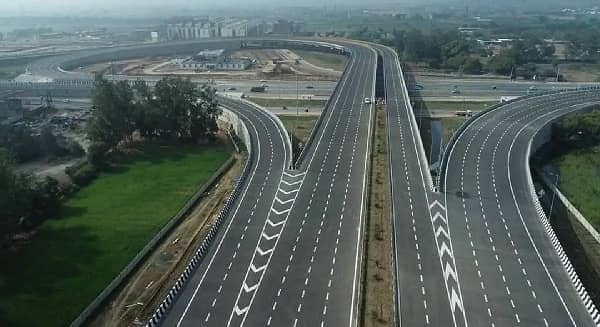
Trans Haryana Expressway Overview
| Detail | Information |
| Official Name | Trans-Haryana Expressway / Ambala-Narnaul Expressway |
| Highway Number | NH-152D |
| Maintained By | National Highways Authority of India (NHAI) |
| Length | 227 km |
| Lanes | 6-lane access-controlled greenfield |
| From (North) | Ghangheri village, Kurukshetra District (near Ismailabad/Ambala) |
| To (South) | Surana village, Mahendragarh District (Narnaul Bypass) |
| Opened | August 1, 2022 |
| Project Cost | ₹5,108 crore |
| Right of Way | 70 metres |
| Bridges/Underpasses | 122 |
| Trees Planted | 1,36,000 (along either side) |
| Districts Covered | Kurukshetra, Kaithal, Karnal, Jind, Rohtak, Bhiwani, Charkhi Dadri, Mahendragarh |
| Part of | Ambala-Kotputli Economic Corridor (313 km) |
| Distance Savings | Reduces Ismailabad-to-Narnaul distance by ~35 km |
| Key Intersections | NH-152 at Gangheri; 15 National Highways; NH-148B toward Kotputli |
| Development Programme | Bharatmala Pariyojana |
Route and Location
The Trans-Haryana Expressway cuts through approximately 112 villages in eight districts, running broadly from the northern plains near Ambala through the agricultural belt of Kaithal, Jind, and Rohtak, then southward through Bhiwani and Charkhi Dadri before reaching the semi-arid zone of Mahendragarh in south Haryana near the Rajasthan border. The route connects the Punjab-border industrial zone of Ambala to the Rajasthan border near Narnaul — an alignment that had no direct high-speed road linkage before 2022.
Connectivity
The expressway intersects the Delhi-Amritsar-Katra Expressway near Pilu Khera/Jind, creating an important future interchange point for North India’s road network. Its connection to NH-148B onward to Kotputli makes it the practical Delhi bypass for Jaipur-bound traffic from Punjab and north Haryana. The 22.85-kilometre Jalbehra-Shahbad link under construction will further strengthen its connection to the existing NH-152G network.
Nearby Areas
Kurukshetra — the battlefield of the Mahabharata and one of Hinduism’s most sacred pilgrimage zones — is the historically significant city at the expressway’s northern end. The Brahma Sarovar tank and the Kurukshetra Panorama & Science Centre draw religious and cultural tourism from across India through this corridor. Rohtak, an important Haryana commercial and educational city, is in the expressway’s mid-section zone.
Frequently Asked Questions (FAQs)
Q1. What is the Trans Haryana Expressway?
A: NH-152D, a 227-km six-lane greenfield expressway connecting Ambala (Kurukshetra) to Narnaul (Mahendragarh), bypassing Delhi. Opened August 1, 2022.
Q2. How much did the Trans Haryana Expressway cost?
A: ₹5,108 crore under Bharatmala Pariyojana, with 122 bridges/underpasses and 1,36,000 trees planted along the route.
Q3. Which districts does the Trans Haryana Expressway pass through?
A: Eight: Kurukshetra, Kaithal, Karnal, Jind, Rohtak, Bhiwani, Charkhi Dadri, and Mahendragarh.
Q4. How does the Trans Haryana Expressway benefit Delhi-Jaipur travelers?
A: It provides a shorter alternate route — reducing Ambala-to-Kotputli distance by approximately 35 km by bypassing Delhi’s congested arterials.
Q5. What larger corridor is the Trans Haryana Expressway part of?
A: The 313-km Ambala-Kotputli Economic Corridor under Bharatmala, intersecting 15 national highways across Haryana.