
MDF vs HDF is a choice many Indian homes have already made without the owners realising it. The laminate floor in a typical city flat sits on an HDF core, the moulded skin of many bedroom doors is HDF, and the painted panel behind the TV is most likely MDF. Both boards are made from the same raw material: wood fibre bound with resin. What separates them is how hard that fibre is pressed. That single factor changes how each board handles weight, water, screws and paint, and it decides which one belongs in your kitchen, wardrobe or living room.
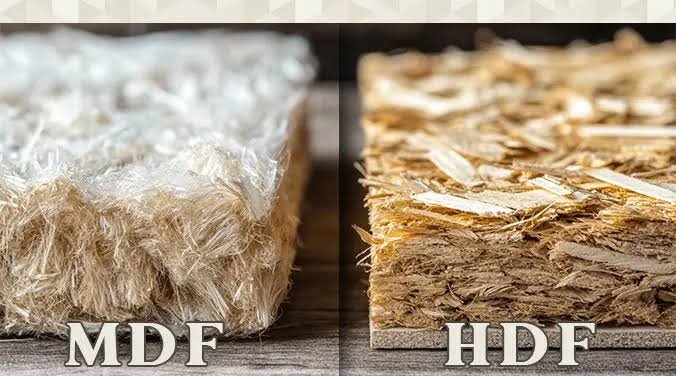
Same Fibre, Different Pressure
Manufacturers break down wood chips, usually from plantation species like eucalyptus, rubberwood or poplar in India, into fine fibres. These are mixed with resin and pressed into flat sheets under heat.
MDF, or medium density fibreboard, generally falls between about 600 and 800 kg per cubic metre. HDF, high density fibreboard, is pressed harder and usually sits above 800 kg, often reaching 900 to 1,000 kg. HDHMR, the green or grey board now common in modular kitchens, is a moisture-resistant form of HDF that Indian brands developed for interior furniture.
Thin HDF (3 mm to 6 mm) is widely used as wardrobe backs and drawer bottoms. Thicker HDF and HDHMR (8 mm to 25 mm) is used for shutters and full furniture.
Five Things That Change With Density
Strength and Screw Grip
Tighter fibres hold screws better. HDF grips hinge screws, handles and channel fittings more firmly than MDF, and it resists dents from bumps with a vacuum cleaner or a child’s toy car. MDF holds well too, but it’s happier with fittings that aren’t removed and refitted often.
Moisture
This is HDF’s biggest advantage. Because it’s denser and usually made with water-resistant resin, it swells far less when exposed to damp. In Mumbai, Chennai, Kochi or Kolkata, that matters for kitchen shutters and anything near a washbasin. Regular MDF works beautifully in dry spaces like bedrooms, study rooms and living areas.
Weight
An 8 × 4 ft sheet at 18 mm holds about 0.054 cubic metres of board. At 700 kg per cubic metre, an MDF sheet weighs roughly 38 kg. The same sheet in HDF at 900 kg comes to around 48 kg. Your carpenter will feel that difference on the fourth-floor stairs, and your hinges will feel it for years.
Machining and Finish
MDF is the easier board for deep CNC carving, 3D wall panels, curved edges and router grooves. It cuts smoothly and saves tool wear. HDF also machines cleanly and gives very sharp detail on thin jaali panels, though it’s harder on cutters.
Both take paint, PU and duco well. MDF edges are more porous, so a sealer coat before paint gives a smoother result.
Price
Plain interior MDF typically costs around ₹40 to ₹70 per square foot in 18 mm. HDHMR boards generally range from about ₹60 to ₹130 per square foot, with pre-laminated versions priced higher. For a large wall-paneling job, MDF can cut the board bill nearly in half.
Matching the Board to the Job
Choose MDF for:
- Fluted and grooved wall panels in living and dining rooms
- TV unit backs, headboards and decorative ceiling panels
- Painted bedroom furniture and study units in dry rooms
- CNC-carved mandir backs and room dividers
- Projects where budget matters more than long-term moisture exposure
Choose HDF or HDHMR for:
- Kitchen shutters and wall cabinets
- Bathroom vanity shutters, using exterior-grade HDHMR
- Wardrobe shutters in coastal or very humid cities
- Laminate flooring, where it forms the core layer
- Wardrobe backs and drawer bottoms in thin 3 mm to 6 mm sheets
Many interior designers use both in one home: HDHMR in the kitchen and bathrooms, MDF for wall features and bedroom furniture.
Plan the Hinges for Heavy Shutters
Here’s a detail that often gets missed. A 6 ft × 2 ft shutter in 18 mm HDHMR weighs about 18 kg, compared with around 14 kg in MDF. That extra weight sits on the hinges every time the door swings.
- Use at least three hinges on shutters taller than 4 ft.
- Use four hinges on full-height 7 ft shutters.
- Choose soft-close hinges from a known brand rated for the shutter weight.
- Ask for a quick fit check once the shutters settle after a month.
Telling Them Apart at the Shop
Boards look alike once laminated, so a few quick checks help.
- Ask for the density printed on the sheet or invoice.
- Compare weight by lifting a corner of each sheet.
- Look at the cut edge. HDF edges look tighter and smoother, while MDF edges feel slightly softer.
- Check the colour code. Green or grey usually signals moisture-resistant HDHMR, while plain brown is standard interior MDF.
- Ask for the emission rating; E1 or E0 boards are a better fit for bedrooms.
FAQs
Q1. What is the main difference between MDF and HDF?
A: HDF is pressed to a higher density than MDF, which makes it stronger, heavier and more resistant to moisture.
Q2. Is HDF waterproof?
A: HDF is water-resistant rather than fully waterproof, so it handles kitchen humidity well but still needs sealed edges.
Q3. Is HDHMR the same as HDF?
A: HDHMR is a type of HDF made with extra moisture resistance, designed mainly for kitchen and wardrobe furniture.
Q4. Which is better for wall paneling, MDF or HDF?
A: MDF is usually the better choice for wall paneling because it’s lighter, easier to carve and more affordable.
Q5. Can HDF be painted?
A: Yes, HDF takes paint, PU and duco finishes very well and needs less sealing on the edges than MDF.
Q6. Is HDF good for modular kitchens?
A: HDHMR, the moisture-resistant form of HDF, is one of the most popular choices for modular kitchen shutters in India.