
Particle board vs MDF decides more about how long a wardrobe lasts than the laminate colour or the handle design ever will. Both boards dominate ready-to-assemble wardrobes sold online and in furniture stores across India, and from the outside they often look identical under a pre-laminated wood-grain or matte finish. The difference sits in the core. Particle board is made from wood chips and sawdust, while MDF uses finely ground wood fibre. That affects how much weight your shelves can carry, how well hinges stay put and how the wardrobe copes with a damp monsoon wall.
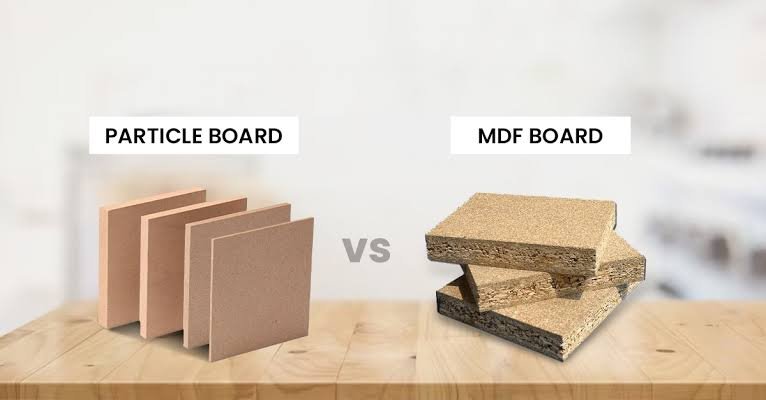
Chips Versus Fibres
Particle board, sometimes called chipboard, is made by mixing wood chips, shavings and sawdust with resin and pressing them into sheets. Break a piece and you’ll see a coarse, slightly granular core with finer particles on the outer faces. In India, general-purpose particle board falls under IS 3087, and pre-laminated versions under IS 12823. It’s a smart use of sawmill leftovers and is the most economical board on the market.
MDF goes a step further in processing. Wood is broken down into individual fibres before pressing, so the core is uniform and smooth all the way through. That’s why MDF can be routed, painted and shaped, while particle board is almost always sold pre-laminated with the finish already bonded at the factory.
Particle board generally sits around 600 to 700 kg per cubic metre, a little lighter than standard MDF.
The Wardrobe Stress Test
A wardrobe faces specific daily demands. Here’s how each board handles them.
The Hanging Rail
A fully loaded rail of jackets, shirts and winter coats can easily reach 20 to 25 kg. The rail brackets are screwed into the side panels, so screw grip matters. MDF holds bracket screws more firmly. Particle board holds them well when the screws go into the panel face with proper plastic inserts or through-bolted brackets.
Shelves
Folded clothes are heavier than they look. Twenty-five folded sarees or a stack of bedsheets on one shelf can weigh around 15 kg. Particle board shelves are best kept to spans of about 30 inches. For wider sections, a centre support or a front edge strip keeps them perfectly flat. MDF shelves handle slightly longer spans before needing support.
Hinges and Drawers
Shutters swing open several times a day, and drawers slide in and out constantly. MDF gives hinge cups and channel screws a firmer bed, which keeps doors aligned longer. Particle board works best with hinges using euro screws or dowels designed for chipboard, which most quality flat-pack brands already include.
Damp Walls
Wardrobes on external walls see some humidity during the monsoon, especially in coastal cities. Both boards prefer dry conditions, though MDF’s denser edges absorb moisture a little more slowly. With every edge sealed by PVC banding and a small gap left between the wardrobe back and the wall, both boards stay in good shape.
What a Two-Door Wardrobe Costs in Board
A standard two-door wardrobe of about 6.5 ft by 4 ft uses roughly four 8 × 4 ft sheets, or around 128 square feet of board.
Pre-laminated particle board is commonly available from about ₹30 to ₹55 per square foot, depending on brand and thickness. Pre-laminated MDF usually costs more, often ₹55 to ₹85. Taking ₹40 and ₹65 as typical figures, the board cost works out to about ₹5,100 for particle board and ₹8,300 for MDF, a gap of around ₹3,200.
For a student flat, a rented home or a guest room, that saving is genuinely useful. For a master bedroom wardrobe you’ll use daily for a decade, MDF’s extra strength is worth the difference.
Who Should Pick Which
Particle board makes sense when:
- You’re furnishing a rented flat or a first job’s PG room on a tight budget
- The wardrobe holds light clothes in a guest room or kids’ room
- You’re buying a flat-pack unit that will be assembled once and left in place
- You want a ready pre-laminated finish without any painting
MDF suits you better when:
- The wardrobe is a long-term piece for the main bedroom
- You want a painted, PU or duco finish on the shutters
- Shelves will carry heavy linen, sarees or luggage
- You prefer grooved, profiled or handle-less shutter designs
- The wardrobe may be dismantled and reassembled during a house move
A practical middle path used by many families is MDF shutters with particle board for internal shelves and partitions. You get a refined look on the outside and keep costs down on the inside.
Getting More Years Out of Either Board
A few habits help any wardrobe last longer.
- Make sure every cut edge, including hidden ones, is sealed with edge-banding.
- Leave a 10 to 15 mm gap between the wardrobe back and an outer wall.
- Spread heavy items across shelves rather than stacking one shelf high.
- Tighten hinge screws gently once a year, without over-tightening.
- Keep a dehumidifier pouch or silica sachets inside during the monsoon months.
- Wipe spills straight away, especially near the bottom panel.
FAQs
Q1. Is particle board good for wardrobes?
A: Yes, pre-laminated particle board works well for budget and light-use wardrobes, especially in dry rooms with moderate loads.
Q2. Which is stronger, particle board or MDF?
A: MDF is stronger and holds screws better, so it handles heavier shelves and frequent door use more comfortably.
Q3. How long does a particle board wardrobe last?
A: A well-made particle board wardrobe usually lasts 5 to 8 years with normal use and dry conditions.
Q4. Can particle board be painted?
A: Particle board isn’t ideal for painting because of its coarse core, so it’s normally sold with a factory laminate finish.
Q5. Is MDF worth the extra cost for a wardrobe?
A: For a main bedroom wardrobe used daily, MDF’s better strength and finishing options usually justify the higher price.
Q6. How can I tell particle board from MDF?
A: Look at a cut or drilled edge: particle board shows visible chips, while MDF has a smooth, even fibre core.