
UPVC doors vs aluminium doors is, for most Indian families, a balcony question. It comes up when choosing the big sliding door between the living room and the balcony, the French door to a terrace garden, or the glazed door to a utility area. Both materials have largely replaced wooden frames for these openings because they don’t rot, swell or attract termites. The difference lies in how they handle heat, noise, salty air and very large glass panels. A flat facing a busy road in Bengaluru and a sea-facing apartment in Goa may each be better served by a different choice.
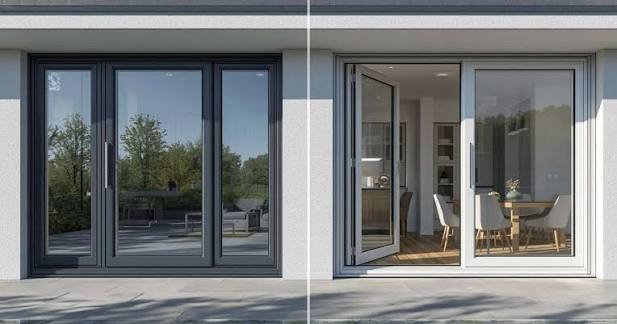
Two Very Different Frames
UPVC stands for unplasticised polyvinyl chloride, a rigid, weather-resistant plastic. Door profiles are extruded with several hollow chambers inside, and a galvanised steel reinforcement runs through the main chamber for strength. Rubber EPDM gaskets seal the sash against the frame. Good profiles sold in India use lead-free, UV-stabilised formulations designed for tropical sun.
Aluminium doors are made from extruded aluminium alloy sections, finished with powder coating or anodising. Local fabricators use standard sections, often called domal or economy profiles, while branded system aluminium uses engineered profiles with precise hardware, multi-point locks and better seals. Premium systems add a thermal break, a strip of polyamide separating the inner and outer metal.
Five Situations That Decide the Choice
A Flat Facing a Busy Road
UPVC has a clear advantage here. Its multi-chamber frame and tight gaskets, combined with double-glazed units, cut traffic noise noticeably. Homes near highways, metro lines or busy markets in cities like Delhi, Pune or Hyderabad feel calmer with a well-installed uPVC slider. Branded aluminium systems with good seals and double glazing also perform well, at a higher price.
A West-Facing Balcony
Aluminium conducts heat roughly a thousand times faster than uPVC. A standard aluminium frame facing the afternoon sun can feel hot to the touch, and that heat moves indoors. UPVC frames stay much cooler, which helps air-conditioned rooms. A thermally broken aluminium system closes most of this gap.
A Sea-Facing Home
Both perform well near the coast, which is why they’ve replaced iron and wood in so many seaside homes. UPVC simply doesn’t corrode. Aluminium also resists rust, and with marine-grade powder coating or thick anodising it handles salty air in Mumbai, Chennai or Kochi comfortably for decades. Stainless steel hardware is worth specifying with either material.
A Wide Opening With a View
Aluminium shines when the opening is large. Its strength allows slim frames and big glass panels, so a 12 ft or 16 ft sliding door looks almost frameless. Lift-and-slide aluminium systems carry very heavy glass smoothly. UPVC frames are bulkier and suit standard balcony widths best, though premium uPVC systems handle fairly large openings too.
Dust and Monsoon Rain
Indian balconies face dust storms in the north and driving rain everywhere during the monsoon. UPVC’s gasketed design keeps out dust and water well. Aluminium sliders perform equally well when they include brush seals, interlocks and properly sloped drainage tracks. With either, ask about drainage slots and track depth.
Price for a Typical Balcony Slider
Rates vary by city, brand, glass and hardware, but 2026 market ranges give a useful picture. UPVC sliding doors typically cost about ₹550 to ₹700 per square foot at the basic level, ₹800 to ₹1,000 for standard branded options and ₹1,200 to ₹1,600 for premium systems. Standard powder-coated aluminium sliders usually fall around ₹450 to ₹900 per square foot, while branded system aluminium with slim profiles can reach ₹2,000 or more.
Take a 7 ft × 7 ft balcony opening of 49 square feet:
- Local powder-coated aluminium at ₹650 comes to about ₹31,900.
- A standard branded uPVC slider at ₹900 comes to about ₹44,100.
- A slim branded aluminium system at ₹1,800 comes to about ₹88,200.
So aluminium sits at both ends of the price scale, with uPVC in the middle. GST, fitting and hardware upgrades come on top.
Looks and Finishes
Aluminium offers the widest range of colours, including black, champagne, bronze, grey and wood-grain powder coats. Its slim sightlines suit contemporary homes with large glass walls.
UPVC is most common in white, with laminated foil finishes in oak, walnut, anthracite grey and other shades. It looks clean and neat, with slightly wider frames that many homeowners find suits apartment balconies well.
Both are long-lasting. Good uPVC doors generally serve 25 to 30 years, and quality aluminium systems can last even longer. Both materials are recyclable.
Points to Check in a Quotation
- Ask for the profile brand and series name, not just “uPVC” or “aluminium”.
- Confirm whether the uPVC profile has galvanised steel reinforcement.
- For aluminium, check the coating type and thickness, especially near the sea.
- Ask whether the price includes toughened or double-glazed glass.
- Check the roller quality and the number of locking points.
- Confirm the mosquito mesh option, since many Indian homes need one on balcony sliders.
- Get warranty terms for the profile, glass and hardware separately.
FAQs
Q1. Which is better for a balcony, uPVC or aluminium?
A: UPVC is better for noise and heat insulation, while aluminium is better for wide openings and slim, modern frames.
Q2. Do aluminium doors get hot in summer?
A: Standard aluminium frames can get warm in direct sun, but thermally broken aluminium systems stay much cooler.
Q3. Are uPVC doors suitable for coastal homes?
A: Yes, uPVC doesn’t corrode, which makes it a strong choice for sea-facing homes.
Q4. Which lasts longer, uPVC or aluminium doors?
A: Both are very durable; good uPVC lasts 25 to 30 years and quality aluminium systems often last longer.
Q5. Is uPVC cheaper than aluminium?
A: UPVC usually costs more than local aluminium but less than branded aluminium system doors.
Q6. Can uPVC doors be used for large openings?
A: UPVC works well for standard balcony sizes, while very wide openings are usually better suited to aluminium.