
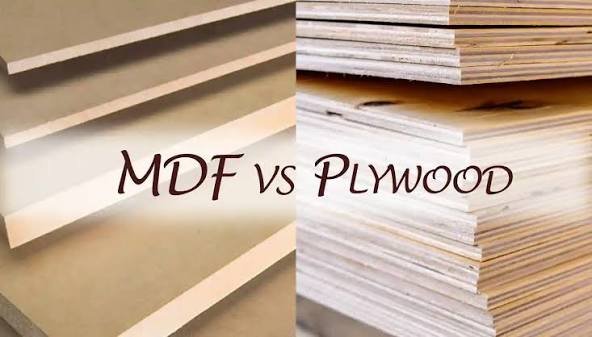
Plywood vs MDF can mean a difference of ₹6,000 to ₹8,000 on a single bedroom wardrobe, and that gap is often why the two boards end up side by side on an interior quote. They look similar once laminated, and both come in standard 8 × 4 ft sheets. Inside, they’re built very differently. Plywood is real wood veneer layered and glued, while MDF is wood fibre pressed into a dense, smooth slab. That difference decides how each board handles screws, weight, moisture and paint. Here’s how to match each one to the right piece of furniture in an Indian home.
What You’re Actually Paying For
Plywood
Plywood is made by stacking thin wood veneers with the grain of each layer running at right angles to the next, then bonding them under heat and pressure. Indian ply usually has a core of eucalyptus, poplar or gurjan. Grades matter a lot here. MR (moisture resistant) plywood follows IS 303 and suits dry rooms. BWP (boiling waterproof) or marine plywood follows IS 710 and is bonded with phenolic resin, so it handles kitchens and bathrooms.
MDF
MDF, or medium density fibreboard, is made from fine wood fibres mixed with resin and pressed into sheets, covered by IS 12406. It has no grain, no knots and no gaps, so the surface is perfectly even edge to edge. A denser version, HDHMR (high density high moisture resistant board), sits at around 850 kg per cubic metre and has become popular for kitchen and wardrobe shutters.
Where Plywood Earns Its Price
Plywood’s cross-layered build gives it strength in every direction. That pays off in furniture that carries load or gets opened hundreds of times a month.
- Screws and hinges grip firmly, even after being removed and refitted during a house shift.
- Long shelves loaded with books or steel utensils sag far less.
- BWP ply can sit under a kitchen sink or inside a bathroom vanity without swelling.
- Bed frames, storage boxes and study tables stay rigid for 15 to 20 years when built from good 18 mm ply.
For anything structural, such as wardrobe carcasses, kitchen base units and bed boxes, plywood remains the safer choice.
Where MDF Does the Job Better
MDF shines wherever finish matters more than load. Its smooth face takes paint, PU, duco and membrane coatings without any grain showing through, which is why matte-painted shutters in modern apartments are almost always MDF or HDHMR.
It also cuts cleanly on a CNC machine. Jaali partitions, mandir backs with fretwork, fluted TV panels and wall cladding come out crisp in MDF, while plywood can chip at the edges during the same work.
Plain interior MDF also costs noticeably less. That makes it a sensible pick for:
- TV unit back panels and decorative wall paneling
- Wardrobe and kitchen shutters with a painted finish
- Kids’ room furniture that may be redone in five or six years
- Display units and showcases holding light items
The one area to plan carefully is moisture. Regular MDF absorbs water through cut edges, so edge-banding on every exposed side keeps it in good shape.
The Wardrobe Maths
A 7 ft tall, 6 ft wide three-door wardrobe typically uses around six 8 × 4 ft sheets of 18 mm board, or about 190 square feet. Current dealer rates put branded 18 mm MR plywood roughly between ₹75 and ₹110 per square foot, while interior-grade MDF usually sits around ₹40 to ₹70, with HDHMR between ₹60 and ₹130.
At ₹85 for MR ply, the board alone costs about ₹16,000. In plain MDF at ₹50, it drops to around ₹9,500.
Most good carpenters suggest a middle path: plywood for the carcass and MDF or HDHMR for the shutters. Since shutters take only about 1.5 sheets, the saving is smaller than many people expect, perhaps ₹1,500. The real gain is the smooth painted finish on the part everyone sees.
A Room-by-Room Pick
- Kitchen: BWP plywood for base units near the sink, MR ply or HDHMR for wall units.
- Bedroom wardrobe: Plywood carcass, MDF or HDHMR shutters for paint finishes.
- Bed and storage boxes: 18 mm plywood, since they carry heavy weight.
- Living room: MDF for TV panels, fluted walls and jaali screens.
- Bathroom vanity: BWP or marine plywood only.
- Study table: Plywood top for daily leaning and laptop weight, MDF for drawer fronts if you want a painted look.
Checks Before the Sheets Arrive Home
A few minutes at the dealer’s shop saves trouble later.
- Look for the IS mark on plywood (IS 303 or IS 710) and match it to the room.
- Ask about the emission rating. E1 or E0 boards release less formaldehyde, which matters in bedrooms and small flats.
- Check ply edges for gaps or overlapping veneers in the core layers.
- Tap MDF sheets; dense boards sound solid and feel heavy for their size.
- Confirm that borer and termite treatment comes with the plywood warranty.
FAQs
Q1. Is plywood stronger than MDF?
A: Yes. Plywood’s cross-layered veneers give better screw grip and load-bearing strength, especially for carcasses, shelves and beds.
Q2. Can MDF be used for kitchen cabinets?
A: HDHMR works well for kitchen shutters and wall units, but BWP plywood is the better choice for cabinets near the sink.
Q3. Which lasts longer, plywood or MDF?
A: Good plywood usually lasts 15 to 20 years or more, while MDF lasts well for 8 to 12 years when kept dry and edge-banded.
Q4. Is MDF good for wardrobes in India?
A: MDF is excellent for wardrobe shutters with a painted finish, while the main frame works best in plywood.
Q5. What is the difference between MDF and HDHMR?
A: HDHMR is a denser, more moisture-resistant form of fibreboard, making it stronger and better suited to kitchens than regular MDF.
Q6. Which is cheaper, plywood or MDF?
A: Interior-grade MDF is usually 30 to 45 percent cheaper per square foot than branded MR plywood of the same thickness.