
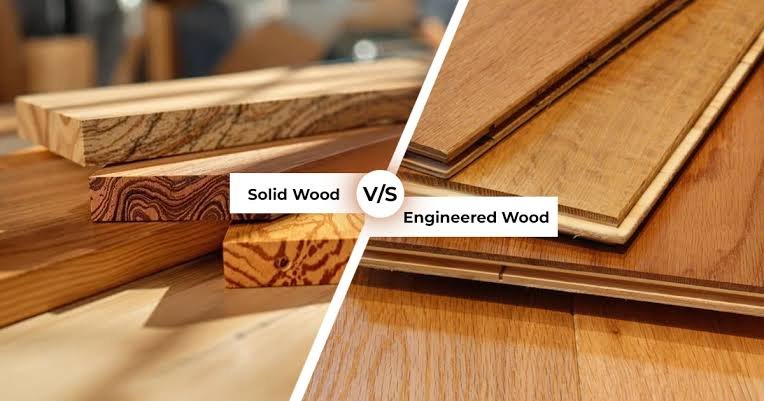
Solid wood doors vs engineered wood doors isn’t really a real-versus-fake debate. A good engineered door is often faced with genuine teak, oak or walnut veneer, and from a metre away it can look identical to a door carved from a single plank. The difference is under the surface. A solid wood door is timber all the way through, while an engineered door is built in layers of wood, veneer and board bonded together. That construction changes how each door behaves in Indian weather, how quickly it can be installed, what it costs and how much it can be repaired decades later.
Solid Wood Doors: Timber All the Way Through
A solid wood door is made from full sections of sawn timber. The vertical stiles and horizontal rails are cut from planks of teak, sal, hollock, meranti or another hardwood, joined at the corners, and filled with solid wood or glass panels.
In India, solid wood doors are most often chosen for main entrances, pooja rooms and heritage-style homes. They feel heavy and substantial, take carving beautifully and can be sanded and re-polished many times over their life. A well-made teak door can easily outlast the family that installed it.
Engineered Doors: Built in Layers
Engineered doors cover several types:
Flush and Veneered Doors
A timber frame filled with a solid or semi-solid core, faced with plywood or HDF and finished in veneer, laminate or paint. These are the everyday doors in most Indian apartments.
Laminated-Core Doors
Premium engineered doors use finger-jointed or laminated timber for the stiles and rails. Short pieces of wood are glued end to end and side by side, with the grain directions mixed, to create a straight and very stable section. A thick hardwood veneer covers the surface.
Moulded Skin Doors
Pressed HDF skins create a panelled look over a light core. They’re usually painted and offer a classic design at a gentle price.
Why Engineered Doors Stay Straighter
Every piece of timber moves with humidity. A single plank expands in the monsoon and shrinks in dry winter, and any natural twist in its grain can show up over time.
Engineered construction balances this movement. When many small pieces with different grain directions are bonded together, their tendencies cancel out. That’s why engineered doors are less likely to bow, twist or stick, even in very humid cities like Kolkata, Mumbai or Thiruvananthapuram. It’s also why many premium solid-looking doors from leading Indian and international brands are engineered inside.
Solid wood doors stay true too, provided the timber is properly seasoned and kiln-dried before the carpenter starts work. Good seasoning is the single biggest factor in a solid door’s long-term performance.
Where Solid Wood Still Leads
Solid timber has strengths no engineered door fully matches.
- Deep, hand-carved designs and brass inlay work
- Unlimited refinishing, since there’s no thin veneer to sand through
- A dense, reassuring weight and a solid sound when closed
- Easy on-site repair of dents, cracks or worn edges
- Strong resale and heirloom value, especially for teak
Installation: Days Versus Hours
A traditional solid wood door is usually built and fitted on site. The carpenter fixes the frame, hangs the shutter, planes it to fit, and then the polisher spends several days on sanding, sealing and coats of finish. That means dust, polish smell and time.
Many engineered doors now arrive as pre-hung door sets, with the shutter, frame, architraves, hinges and lock preparation finished in the factory. A trained team can install one in a few hours with a factory-applied finish already in place. For apartment owners working to a tight move-in date, that convenience counts.
The Teak Arithmetic
Here’s a calculation that explains why engineered doors use timber so efficiently. A veneer of about 0.6 mm thickness means a single cubic foot of teak can theoretically yield around 500 square feet of veneer, and realistically perhaps 300 to 400 after losses. Facing both sides of a 7 ft × 3.5 ft door takes about 49 square feet.
So the teak that goes into one solid door, roughly three to four cubic feet, could face the surfaces of 20 or more engineered doors with real teak veneer.
On price, a well-finished engineered wood door with veneer generally falls in the range of ₹12,000 to ₹35,000, depending on the core, veneer species and finish. A solid teak panel door typically starts around ₹45,000, with carved designs going much higher.
Which Door for Which Opening
Main entrance: Solid teak or sal for a traditional, carved look, or a premium engineered door with thick veneer for a modern home.
Pooja room: Solid wood for carved or bell-and-glass designs.
Bedrooms: Engineered doors with solid cores give quiet, stable and well-finished results.
Bathrooms: Engineered doors with waterproof cores, or WPC doors, handle splashes better than solid timber.
Kids’ rooms and study: Engineered doors with laminate are durable and easy to clean.
Heritage homes and villas: Solid wood doors keep the character consistent throughout.
Before You Order
- Ask what the engineered core is made of: solid timber strips, laminated timber, particle board or honeycomb.
- Check the veneer thickness. Thicker veneers can be lightly refinished in future.
- Confirm that hinge edges have solid wood lipping for a firm screw grip.
- For solid wood, ask for kiln-dried timber and the species name on the invoice.
- Compare warranties on warping and finish.
- See a finished sample door in person before choosing the polish shade.
FAQs
Q1. Are engineered wood doors as strong as solid wood doors?
A: Good engineered doors with solid or laminated timber cores are very strong and often more stable than solid wood.
Q2. Do solid wood doors warp?
A: Properly seasoned solid wood doors rarely warp, which is why kiln-dried timber matters so much.
Q3. Can engineered doors be polished again?
A: Veneered engineered doors can be lightly re-polished, though not sanded as deeply as solid wood.
Q4. Which is better for a main door?
A: Solid teak suits traditional homes, while premium engineered doors with thick veneer suit modern apartments.
Q5. How long do engineered wood doors last?
A: Quality engineered doors generally last 20 years or more with normal care.
Q6. Are engineered wood doors eco-friendly?
A: Yes, they use timber efficiently, since a thin veneer covers far more area than solid planks.