
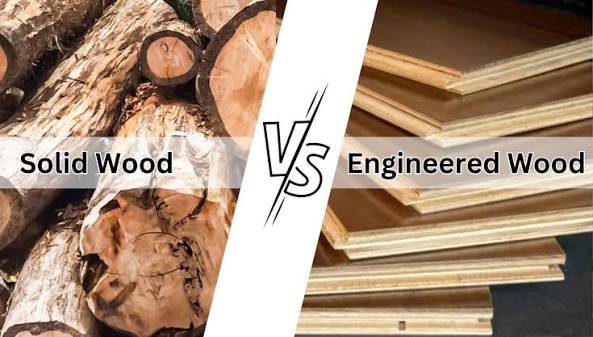
Solid wood vs engineered wood is a question that would have puzzled most Indian households a generation ago, when the local carpenter built every bed, almirah and dining table from sheesham, teak or sal, often right on the family verandah. Today, a large share of furniture sold in India, from modular wardrobes to online flat-pack beds, is made from engineered boards like plywood, MDF and particle board. Both materials make good furniture. Solid wood offers longevity, repairability and natural character, while engineered wood brings stability, clean modern designs and lower costs on large pieces. Which suits you depends on the specific piece, how long you plan to keep it and the look you want.
What Counts as Solid Wood
Solid wood furniture is made from sawn timber planks, with the grain running through the full thickness. Common choices in Indian homes include sheesham, teak, mango wood, acacia, sal and rubberwood.
Each has its own personality. Sheesham is dense with dramatic dark streaks. Teak is golden and naturally oily. Mango wood, sourced from trees past their fruit-bearing years, has become a popular affordable option for dining sets and sideboards. Rubberwood, from plantation trees that have finished producing latex, is widely used in ready-made beds and kids’ furniture.
What Engineered Wood Covers
Engineered wood is any board manufactured by bonding wood layers, strips, fibres or chips with resin. Plywood, blockboard, MDF, HDHMR and particle board all fall under this umbrella. These boards are usually finished with laminate, veneer or paint, so the final piece may look like wood, a solid colour or a high-gloss surface.
Strengths That Matter at Home
Lifespan and Repair
Well-made solid wood furniture can last 40 years or more and often moves from one generation to the next. Scratches can be sanded out, loose joints re-glued and the whole piece re-polished to look fresh again. That’s a big reason solid wood furniture holds resale value.
Engineered furniture made from good plywood or HDHMR typically gives 10 to 20 years of reliable use. Damaged panels are usually replaced rather than repaired, which is simple in modular units.
Stability Through the Seasons
Solid wood is a natural material that absorbs and releases moisture, so it expands slightly in the monsoon and shrinks in dry winters. Good carpenters allow for this with proper joinery and well-seasoned, kiln-dried timber.
Engineered boards move far less because their layers or fibres are arranged to cancel out that movement. That’s why large flat panels such as wardrobe shutters, kitchen cabinets and wall units are almost always built from engineered wood.
Design Freedom
Solid wood excels at carving, turned legs, thick tabletops, rounded edges and chunky frames, all signature details of traditional Indian furniture. Engineered wood suits sleek, handle-less, modular designs with large uninterrupted surfaces and precise CNC cuts.
Weight and Moving
Solid sheesham or teak pieces are heavy and sturdy. Engineered furniture, especially flat-pack, is lighter and easier to dismantle, which suits renters and people who relocate for work.
The Cost Picture Isn’t One-Sided
Many assume solid wood is always far costlier, but it depends on the piece.
Take a 6 ft × 3 ft dining tabletop, about 1.25 inches thick. That’s close to 1.9 cubic feet of finished sheesham, or around 2.5 cubic feet after sawing and planing. At roughly ₹1,800 per cubic foot, the timber costs about ₹4,500. The same top in 25 mm plywood with a good veneer and PU polish could easily cost more in materials. For compact, chunky pieces like tables, chairs and bed frames, solid wood’s material cost is often competitive, though skilled labour adds to the total.
Large flat furniture tells a different story. A full-height wardrobe in solid wood needs wide panels glued from many planks, more seasoning time and more labour. Engineered wood builds the same wardrobe faster and at a noticeably lower overall cost.
Making the Call, Piece by Piece
Dining tables and chairs work beautifully in solid wood, which handles daily use and ages gracefully.
Beds are a fine fit for both. A solid wood frame is very sturdy, while plywood suits beds with hydraulic or box storage.
Wardrobes and kitchen cabinets are better in engineered wood, since large stable panels and modular hardware matter most here.
Sofa frames and centre tables suit solid wood, especially where carving or exposed legs are part of the design.
TV units, study units and bookshelves can go either way. Engineered wood gives a modern look, and solid wood brings warmth.
Kids’ furniture works well in rubberwood for sturdiness or engineered wood for budget and easy updates as children grow.
Reading a Product Listing
Online furniture descriptions can be confusing, so a few checks help.
- “Solid wood finish” or “wood look” usually means engineered wood with a wood-grain laminate.
- Look for the exact material in the specifications, such as “solid sheesham,” “plywood” or “particle board.”
- Ask whether solid wood is kiln-dried and termite-treated.
- For engineered wood, note the board type and thickness, since 18 mm plywood is far sturdier than 15 mm particle board.
- Check whether only the frame is solid wood while panels are engineered, a common and sensible combination.
- Read the warranty for both the material and the joinery.
FAQs
Q1. Is solid wood better than engineered wood?
A: Solid wood lasts longer and can be repaired, while engineered wood is more stable for large panels and usually more affordable.
Q2. How long does engineered wood furniture last?
A: Good-quality plywood or HDHMR furniture typically lasts 10 to 20 years with normal care.
Q3. Which solid wood is best for furniture in India?
A: Sheesham and teak are the most popular choices, with mango wood and acacia offering good value.
Q4. Is engineered wood strong enough for a bed?
A: Yes, 18 mm plywood makes a strong bed, especially for designs with storage boxes.
Q5. Does solid wood furniture crack?
A: Properly seasoned solid wood rarely cracks, which is why kiln-dried timber is worth asking for.
Q6. Why is most modular furniture made from engineered wood?
A: Engineered boards stay flat, come in uniform sheets and suit factory machining, which makes them ideal for modular designs.