
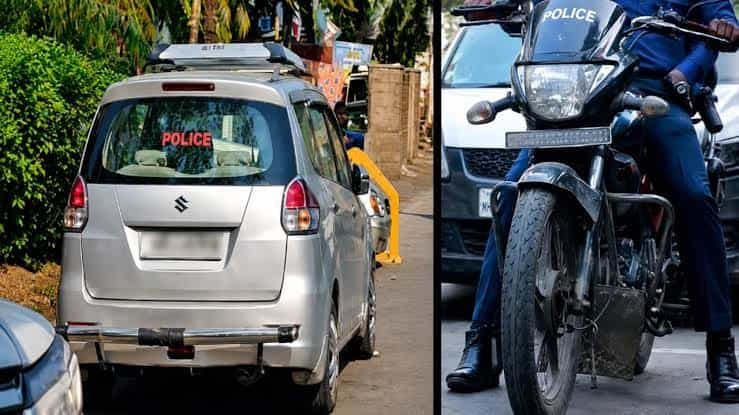
Displaying police or press stickers on private vehicles is illegal in most Indian states unless the vehicle is officially authorised. Several High Courts have said so in plain terms, and traffic police in cities such as Chennai and Mumbai now fine owners for it. Many people still believe a “Press” or “Police” sticker is harmless, or even a small privilege. The law treats it as misuse.
Quick Facts
- Central rule: The Road Transport Ministry told Parliament in March 2025 that it has issued no central guidelines on government stickers for personal vehicles.
- State power: Section 111(2)(e) of the Motor Vehicles Act lets states make rules on particulars displayed on vehicles. Violating them is punishable under Section 177.
- Courts: The Madras, Bombay, Punjab and Haryana, and Madhya Pradesh High Courts have all ordered action against such stickers or related misuse.
- Who can display them: Only officially authorised vehicles, such as those on genuine government duty.
- Penalty: A challan, removal of the sticker, and in some cases further charges.
Why Police and Press Stickers on Private Vehicles Are Illegal
The Motor Vehicles Act has no provision that lets a private owner mark a car “Police” or “Press”. The Centre’s own position, stated in the Rajya Sabha in March 2025, is that no national guideline exists. It pointed to states’ power to frame rules about what a vehicle may display.
States have used that power. Courts have filled the gaps. The pattern across them is consistent: a private vehicle carries its registration plate and little else that claims an official identity.
What the High Courts Have Said
Several benches have addressed this directly.
- Madras High Court: It recorded the state’s assurance of stern action against stickers carrying “Emblem”, “Govt of India”, “High Court” and “Police” on private vehicles. Authorities reported detecting 104,017 such vehicles, with fines of ₹16,56,000 imposed in total. The court called monitoring a continuous process.
- Punjab and Haryana High Court: It prohibited words like High Court, Army, police, press, journalists, chairman and vice-chairman on private vehicles. The court saw such displays as an attempt to browbeat others. Ambulances and fire tenders were exempted.
- Bombay High Court: It ordered Mumbai’s traffic police to penalise “Police” stickers and logos on private vehicles. A separate circular from the court stopped judges’ titles being inscribed on private cars.
- Madhya Pradesh High Court: In a July 2025 order, it told owners to remove flashing lights and sirens and fix non-compliant plates within a week. It also ordered removal of any extra plate above or below the registration plate, except on police and government vehicles.
How Police Actually Penalise It
Enforcement uses ordinary motor vehicle provisions.
Chennai’s traffic police, for example, announced action from May 2024 under two provisions: Section 198 of the Motor Vehicles Act (unauthorised interference with a motor vehicle) and Rule 50 of the Central Motor Vehicles Rules, read with Section 177 (defective number plate). Police said some owners posed as journalists or lawyers to escape after committing offences.
One caution on those charges. The Madras High Court Advocates Association argued that Section 198 covers tampering with a vehicle’s mechanism, and doesn’t clearly reach official stickers. That dispute is live. Section 177, the general penalty provision, is the safer anchor for the offence.
Older sources quote a Section 177 fine of ₹100 for a first offence and ₹300 for repeats. The 2019 amendment raised these penalties, so confirm the current amount with your RTO or traffic police before relying on any figure.
Press, Advocate, Army and Doctor Stickers Are Treated Alike
People often assume “Press” gets different treatment from “Police”. It doesn’t.
Chennai’s order named Press, Police, Doctor, Lawyer, High Court, Chief Secretariat and Army. Mumbai’s circular said the same rule applies to judges and journalists. The Punjab and Haryana court’s list covered press and journalists alongside Army and High Court.
The reasoning is practical. A sticker costs as little as ₹15 in the market, according to Mumbai’s joint commissioner of traffic. Anyone can paste one on a windscreen. Officers then hesitate to stop or check the vehicle, and drivers argue with them when they do. Police told the Madras High Court that the same problem arises with party flags and designation boards.
Advocate Stickers: A Real Exception
The advocate sticker case shows where the line sits.
A bar council issues advocate stickers to enrolled lawyers after checking the vehicle’s registration certificate and the lawyer’s enrolment certificate. The Madras High Court Advocates Association says these exist for entry and parking at court campuses. They are not meant to claim immunity from traffic rules, it said, and it drew a clear distinction between authorised stickers and shop-bought ones.
The Madras High Court has also told the state that police can act against lawyers who use advocate stickers to seek immunity from traffic offences.
An authorised sticker for a specific purpose isn’t the same as a self-applied badge of authority. If a body has issued the sticker and you use it for its stated purpose, you’re on firmer ground. If you bought it at a shop, you’re not.
Official Stickers Do Exist
Officially issued identification is legal. Nagaland offered a notable example: after banning designation plates to end VIP culture, the government said colour-coded car stickers would be provided so ministers and MLAs could move freely. The state, not the vehicle owner, supplied the sticker.
Chandigarh’s transport secretary also clarified that words like “government” can appear on a vehicle while its occupants perform government duty. Everyone else is barred from using words like police, press or court.
So the question to ask isn’t whether a sticker says “Press”. It’s whether an authority issued the sticker and the vehicle is on that duty.
Related Violations That Often Come Bundled
Fake-authority stickers rarely travel alone. Courts and police target the full set:
- Extra plates or boards fixed to the front or rear of a vehicle. A High Court order treated these as an offence under Section 177 and said they should be removed immediately.
- Party flags and organisation flags, which Tamil Nadu’s police chief called unauthorised under law and rules.
- Flashing lights and sirens on private vehicles, which the Madhya Pradesh High Court ordered owners to remove.
- Stickers on windscreens or windows that affect visibility. Rajasthan’s traffic department has also moved against caste, religion, profession and party stickers on private cars.
What To Do If You Already Have One
- Remove it. Chennai gave drivers a short deadline before enforcement began, but you shouldn’t count on a grace period.
- Check that your registration plate carries only the registration number, in the prescribed format.
- If you hold an authorised pass or sticker, such as a bar council sticker, use it only where and how it was meant.
- If a state authority has issued you an official sticker, keep the issuing document in the vehicle.
- If police challan you, you can contest it, but arguing a shop-bought sticker was “authorised” rarely works.
FAQs
Q1. Is it legal to put a “Press” sticker on my private car if I am a journalist?
Generally no. Courts have barred press stickers on private vehicles, including for journalists. Only officially authorised vehicles on duty can display them. Check your state’s rules before using one.
Q2. Can I be fined just for a police logo sticker?
Yes. Mumbai traffic police act against private vehicles with police stickers or logos after a Bombay High Court order. Chennai police book cases under Section 198 and Section 177.
Q3. Are advocate stickers allowed on private cars?
Only authorised ones issued by a bar council, used for court campus access. Misusing them to seek traffic immunity can lead to police action, as the Madras High Court has said.
Q4. What is the fine for a fake government sticker on a vehicle?
It depends on the state and the section applied, usually Section 177. Older sources quote ₹100 and ₹300, but penalties were raised later. Confirm the current amount with your RTO.