
Is driving a foreign-registered car legal in India? Yes, for a visitor on a temporary stay, and only if the paperwork matches. India has two separate gatekeepers: customs decides whether the car can enter without duty, and the transport ministry’s 2022 rules decide how it may be driven once it’s here. Miss either one and a road trip becomes a customs dispute.
Before You Cross the Border: The Essentials
- Road rules: The Motor Vehicles (Non-Transport Vehicles Visiting India) Rules, 2022, notified on 2 September 2022, govern personal foreign cars.
- Customs route: A carnet de passage allows duty-free temporary import for six months.
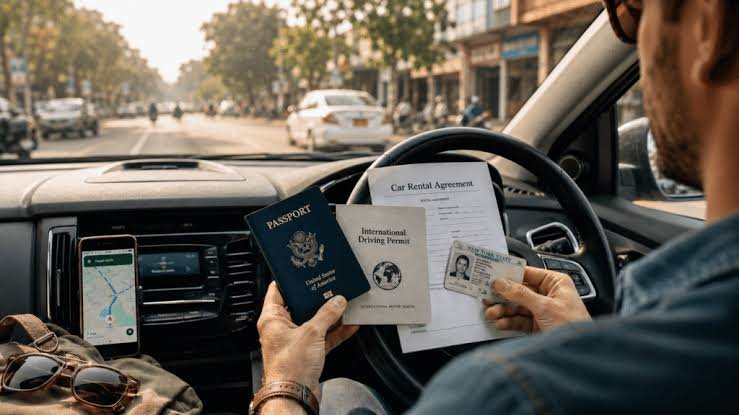
- Paperwork: Registration certificate, driving licence or international driving permit, valid insurance, and a PUC certificate if your home country requires one.
- Language: Documents not in English need an English translation authenticated by the issuing authority.
- Hard limit: The car cannot carry local passengers or goods in India.
What the 2022 Rules Require
The rules formalised what had been a loosely handled area. A foreign-registered private car moving through India must carry:
- A valid registration certificate.
- A valid driving licence or international driving permit, whichever applies.
- A valid motor insurance policy.
- A pollution under control certificate, if applicable in the country of origin.
- Authorised English translations where any document is in another language.
A draft version of the rules went further. It said all documents must stay with the driver from entry through the entire stay, and that vehicles with non-English registration marks must show the vehicle’s identity in English at the front and back. I couldn’t confirm that the final text kept every one of those details, so check the notified version.
One line in the rules matters more than the rest. Vehicles registered outside India are not allowed to transport local passengers or goods inside India. Every foreign car must also follow rules made under India’s Motor Vehicles Act.
The Customs Side: Carnet de Passage
Roads are only half the picture. Bringing a car into India without paying duty depends on a customs document called a carnet de passage.
Customs Circular 77/2003 says vehicles can be imported temporarily for six months without customs duty against a valid carnet issued by a member of an automobile club belonging to the international touring federation. The exemption notification covers customs duty and additional duty.
The conditions are strict:
- The carnet holder must be a member of a recognised automobile club or association.
- The holder must stay in India while the vehicle is retained.
- The vehicle must match, in every respect, what’s described in the carnet. Customs may inspect and record its particulars.
- The exemption excludes people normally resident outside India who take up paid employment or other gainful occupation during their visit.
Some travellers report extensions up to a year, but I found that only in a forum post. Don’t rely on it without customs confirmation.
When Customs Takes the Carnet Seriously
A January 2026 CESTAT Mumbai order shows how this plays out. It dealt with a car brought in against a carnet by someone alleged to have done business in India during his stay. The tribunal noted that duty-free temporary import against a carnet is intended for people resident outside the country to travel in India, and that the car remained under customs control throughout.
The takeaway isn’t the outcome. It’s that customs examines why you came, not just what you drove in. A tourist trip and a working stay get different treatment.
What About Importing the Car Permanently?
This is a different route entirely, and a costly one. One 2026 guide says that importing a ₹50 lakh car can add ₹30-80 lakh in duties and taxes before customs releases it. Another source says foreign nationals working in India can import a car if their employment contract runs at least one year, sometimes with a guarantee of the duty amount plus a margin.
That second source is an older reader-answer page and warns that figures change. Check current rules with Indian customs before planning anything around those numbers.
Cross-Border Driving: Where the BBIN Agreement Stands
If you’re thinking of driving from neighbouring countries, the BBIN Motor Vehicles Agreement is the framework to watch. Bangladesh, Bhutan, India and Nepal signed it on 15 June 2015, to regulate passenger, personal and cargo vehicle traffic among them. Each vehicle would need an electronic permit to enter another member’s territory.
It hasn’t fully arrived. Bangladesh, India and Nepal ratified it, but it enters into force only once all four members have, and Bhutan has held back. The latest source I found says progress on the project has been slow despite several trial runs.
Treat BBIN as a future possibility, not a current right to drive your own car across.
Practical Checklist for Visitors
- Get a carnet de passage through your home automobile club before shipping or driving the car.
- Check that your insurance covers you in India, or arrange cover that does.
- Carry original documents plus authenticated English translations.
- Keep the carnet and customs papers with you throughout the stay.
- Never use the car to carry paying passengers or goods.
- Re-export the car before the carnet period ends, and get the exit recorded so customs doesn’t chase you later.
Customs have, in the past, issued demand notices on cars that had already left the country because the exit wasn’t recorded. A 2003 circular told officers not to confirm such notices routinely, but the safest move is a stamped exit.
FAQs
Q1. Can a tourist drive a foreign-registered car in India?
Yes, on a temporary basis. Carry the registration certificate, driving licence or international driving permit, valid insurance and a PUC certificate if applicable, plus certified English translations where needed.
Q2. How long can the car stay under a carnet?
Customs circulars allow six months duty-free against a valid carnet. Some travellers report extensions up to a year, but confirm with Indian customs before relying on that.
Q3. Can I use my foreign-registered car as a taxi or for deliveries in India?
No. The 2022 rules bar foreign-registered vehicles from carrying local passengers or goods in India. Using one commercially risks penalties and possible customs consequences.
Q4. Can I take a foreign car to India if I’m going there to work?
The carnet exemption excludes visitors who take up paid employment or gainful occupation during their stay. Foreign nationals working in India need a different import route, so check customs rules first.
Q5. Is the BBIN agreement in force for private cars?
Not fully. Bangladesh, India and Nepal ratified it, but it enters into force only when all four members do, and Bhutan has held back.