
Blockboard vs plywood matters most on anything long: a 7-foot wardrobe shutter, a 6-foot bookshelf, a dining table top or a bedroom door that has to stay straight for fifteen years. Plywood is built entirely from thin veneers glued in alternating directions. Blockboard has a core of solid softwood strips, usually pine or rubberwood, sandwiched between veneers on both faces. That core makes it lighter and stiffer along its length, while plywood stays strong in every direction and holds fittings more evenly. For Indian homes, both boards have a clear role, and many good carpenters use them side by side in the same room.
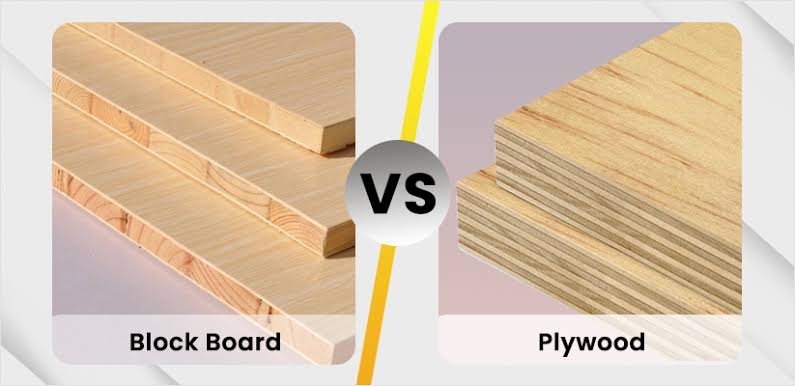
How Each Board Is Built
Plywood is a stack of veneers, each roughly 1.5 to 2 mm thick, with the grain of every layer turned 90 degrees from the one below. An 18 or 19 mm sheet can have nine to thirteen layers. That cross-layering gives balanced strength and very good screw grip on both faces and edges.
Blockboard, made under IS 1659, starts with a frame of wooden strips around 25 mm wide laid edge to edge. A cross-band veneer goes on each side, followed by a face veneer, and the whole sandwich is pressed with resin. Because the core is mostly solid wood rather than glue lines, blockboard is lighter than plywood of the same thickness and needs fewer veneers to reach 25 mm, 30 mm or more.
Why Length Changes the Answer
Wood is strongest along its grain. In blockboard, all the core strips run in one direction, so a sheet cut with the strips running lengthwise resists bending very well over long spans.
This is the main reason blockboard became the traditional choice for doors and shelving across India. A tall shutter or a long shelf made from blockboard stays flat under its own weight and under load for many years.
Plywood spreads its strength across both directions. It’s excellent for parts that face load from several sides, such as carcass panels, drawer boxes and bed frames, but long, unsupported spans in plywood often need an extra partition or a thicker sheet to stay perfectly level.
One practical tip: always tell your carpenter which way the strips run before cutting. Shelves and shutters should be cut with the strips running along the longest side.
Doors: Where Blockboard Shines
Room Doors
Many solid-core flush doors used in Indian apartments have a blockboard-style construction inside, with a timber frame and veneer or laminate faces. They’re lighter on hinges than a solid plywood door of similar thickness and resist warping well. For a standard 7 ft × 3 ft bedroom or bathroom door, a 30 to 32 mm solid-core flush door is a common and dependable choice.
Wardrobe and Kitchen Shutters
Shutters taller than about 6 ft are where blockboard earns its place. Its stiffness keeps tall wardrobe doors from bowing and helps sliding shutters glide smoothly. Lighter weight also reduces strain on hinges and channels.
Tabletops and Long Shelves
Dining tables, study desks and wall-to-wall bookshelves benefit from 25 mm blockboard. Fewer supports are needed, which gives a cleaner look.
Where Plywood Is the Better Fit
Plywood remains the stronger choice for:
- Wardrobe and kitchen carcasses, where panels meet at joints and carry hinges on their edges
- Drawer boxes and small parts that are cut into narrow strips
- Bed frames and storage boxes that take load from several directions
- Sink cabinets and bathroom vanities, using BWP or marine grade
- CNC-cut designs and curved pieces, since blockboard edges can show the core strips when cut across them
- Any piece where screws go into the board’s edge
What It Costs
Rates vary by city and brand. Recent dealer pricing places 19 mm MR-grade blockboard at roughly ₹80 to ₹120 per square foot and BWR-grade blockboard around ₹120 to ₹160. Branded 19 mm commercial plywood is often a little lower, at about ₹55 to ₹95.
At thicker sizes, the balance shifts. A 25 mm or 30 mm plywood sheet needs many more veneer layers and glue lines, so blockboard of that thickness usually offers better value.
For a sliding wardrobe with tall shutters, the shutters typically use about four sheets. At an average gap of ₹30 per square foot between 19 mm blockboard and commercial plywood, that’s around ₹3,800 extra for shutters that stay straighter and lighter for years.
Checking Quality at the Shop
- Look for the IS 1659 mark on blockboard and IS 303 or IS 710 on plywood.
- Check the edge of the blockboard. Strips should be tightly packed and evenly sized.
- Tap across the face; a consistent solid sound suggests no gaps in the core.
- Lift the sheet. Good blockboard feels firm and lighter than plywood, while very light sheets may have a loosely packed core.
- Ask whether the softwood core is borer-treated. Leading brands include this as standard.
- Choose BWR-grade blockboard for kitchens and humid cities.
FAQs
Q1. Is blockboard stronger than plywood?
A: Blockboard is stiffer along its length and better for long spans, while plywood is stronger in all directions and holds screws better.
Q2. Which is better for doors, blockboard or plywood?
A: Blockboard is generally better for doors and tall shutters because it’s lighter and stays straight over long lengths.
Q3. Can blockboard be used in kitchens?
A: Yes, BWR-grade blockboard works for kitchen shutters, while the sink cabinet is best made from BWP or marine plywood.
Q4. What thickness of blockboard is best for doors?
A: 19 mm suits wardrobe shutters, while 25 to 32 mm is commonly used for room doors and tabletops.
Q5. Is blockboard cheaper than plywood?
A: At 19 mm, blockboard often costs about the same or slightly more, but at 25 mm and above it’s usually more economical.
Q6. Why does blockboard need care when cutting?
A: Cutting across the core strips can expose gaps at the edge, so it’s best cut along the strip direction and finished with edge-banding.